
Why Start an Insurance Career on the South Carolina Coast?

Myrtle Beach to Hilton Head
Get licensed for the corridor where good agents are scarce.
Quick Answer
- Coastal property is the most valuable specialty a new South Carolina agent can learn. Homes near the water often carry three separate policies instead of one, and clients genuinely need someone who can explain how they fit together.
- The expertise is learnable, not gatekept. Three policy types, three deductible structures, and one state mitigation program. Master those and you know more than most agents in the state.
- South Carolina makes the entry fast. The state does not require pre-licensing education before the exam, so the distance between deciding and working is measured in weeks.
Most new agents start where the business is easiest and the competition is thickest. There is another option in South Carolina, and it sits along the coast from Myrtle Beach through Charleston to Hilton Head. The coverage there is more layered than a standard homeowners placement, which is exactly why homeowners in those counties want an agent who understands it, and exactly why fewer agents have bothered to learn.
That gap is an opportunity, and it is a very learnable one.
What Makes the Coastal Market Different?
Inland South Carolina works the way property insurance works almost everywhere. One policy, one carrier, one renewal, wind included.
Closer to the water, coverage gets assembled rather than purchased. Carriers price wind risk separately from everything else, so the protection a coastal homeowner needs often arrives as more than one contract. Nothing about that is broken. It is how a market prices a real risk honestly, and it creates a job that a knowledgeable person does well and an unprepared person does badly.
For someone choosing where to build a book, three things make this attractive early:
- Less competition. Plenty of agents avoid coastal placements because the first one takes effort to learn. That thins the field considerably.
- Clients who value expertise. Coastal homeowners have usually been confused by this before. An agent who explains it clearly becomes the one they recommend.
- Referral sources that repeat. Closing attorneys, lenders, and real estate agents along the coast all need someone reliable to send buyers to, and they send them constantly.
Why Do Coastal Homes Need More Than One Policy?
This is the core knowledge, and it takes about ten minutes to learn and a career to use well.
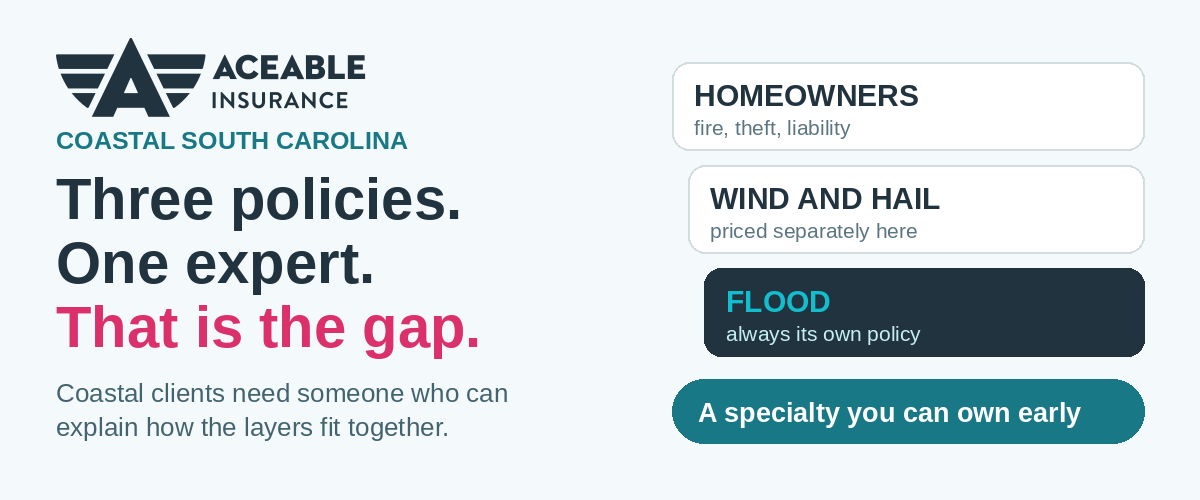
The Homeowners Policy
Covers what a homeowners policy always covers: fire, theft, liability, and the rest. Near the coast, many carriers exclude wind and hail from this form and price it elsewhere.
The Wind and Hail Policy
That coverage gets purchased separately, either from a private market or surplus lines carrier or through the South Carolina Wind and Hail Underwriting Association, which exists specifically to make essential coastal coverage available in the designated coastal area east of the Intracoastal Waterway. The association is not a fallback for difficult cases. It is a functioning part of how coastal property gets insured, and knowing how to use it is a normal professional skill.
The Flood Policy
Flood is separate from homeowners coverage everywhere in the country, not just here. Federal flood coverage carries a waiting period before it takes effect, with an exception when the policy is tied to a loan closing. That single fact has saved a lot of closings, and knowing it early makes you useful to every lender you meet.
Three contracts, one house. An agent who can walk a client through that in plain language has already done the most valuable part of the job.
What Are the Three Storm Deductibles?
This is the detail that makes clients trust you, because almost nobody explains it to them.
- Windstorm deductible. The broadest. Applies to wind damage generally, including from storms that never got a name.
- Named storm deductible. Applies once a tropical system has been named, so it captures tropical storms as well as hurricanes.
- Hurricane deductible. The narrowest. Applies only when the event meets the policy's specific hurricane definition.
Two more things worth knowing. These deductibles are often expressed as a percentage of the dwelling limit rather than a flat figure, so a client's share scales with the value of their home. And some carriers apply the deductible separately to the building and the contents.
Explaining that clearly at binding, before anyone needs it, is the difference between a client who feels informed and one who feels blindsided. It costs you five minutes and buys you a relationship.
Choose a State and Course
What Coastal P&C Agents Earn
How South Carolina agent pay shifts by market.
Why Is Mitigation the Best Skill to Learn First?
Here is the part of this specialty that feels genuinely good to do.
South Carolina helps coastal homeowners make their houses stronger. The Department of Insurance administers the SC Safe Home mitigation grant program, which funds wind mitigation retrofits for eligible owner-occupied single-family homes in the coastal counties: stronger roof deck attachment, sealed roof decks, reinforced roof edges, and impact-rated or protected openings.
Completed work can earn SC Safe Home certification, IBHS FORTIFIED designation, or both. Carriers offer discounts on the wind portion of the premium for those designations, and because the discount varies by carrier, figuring out what a certification is actually worth to a specific homeowner takes an agent.
So the agent who learns this does three things at once: helps a family protect their home, lowers their coverage cost, and becomes the person they call about everything else. That is a good way to build a book, and the SCDOI publishes program details and eligibility.
Which License Do You Need for This Work?
Coastal property work runs on a property and casualty license. That is the credential that lets you sell homeowners, wind, and the rest of the property lines, and our overview of what you can do with a P&C license covers the full range it opens up.
Many coastal agents eventually add life and health as well, because the same clients need both and cross-selling is where income compounds. The SC career paths guide maps how the lines connect to roles.
The path itself is short. South Carolina does not mandate pre-licensing education before the state exam, which is unusual and works in your favor, though the exam is comprehensive enough that preparation still matters. Our breakdown of SC pre-licensing rules explains what is required versus what is simply smart, and the SC exam prep guide covers what the test actually asks.
After you are licensed, market access comes through carrier appointments, and how many you can hold depends on whether you go captive or independent. That choice matters more on the coast than anywhere else in the state, because multi-carrier access is what lets you place wind risk that a single carrier may decline.
What Can Slow Down Getting Started?
- Skipping preparation because the state does not require it. No mandated coursework is a speed advantage, not a signal that the exam is easy.
- Waiting on the exam application window. Scores stay valid for a limited period, so line up fingerprinting and your NIPR application to follow closely behind your pass.
- Holding one line when your clients need two. Coastal homeowners are also life and health prospects, and adding the second line later costs more momentum than adding it early.
- Going independent before you have appointments. Multi-carrier access is the coastal advantage, and new agents often build toward it through an IMO or FMO rather than winning direct appointments immediately.
- Learning the products but not the programs. Mitigation grants have application windows that open periodically rather than staying open, so knowing the calendar is part of the expertise.
How Does South Carolina Compare to Other Coastal States?
Florida is the obvious comparison, and the mechanics rhyme: residual markets, mitigation programs, percentage hurricane deductibles. The differences favor a new agent here.
The territory is concentrated. South Carolina's coastal counties form a defined corridor rather than most of a state. One agent can learn that corridor thoroughly and serve it well, which is a realistic goal in the first few years.
You get two markets in one license. Inland South Carolina, including Greenville, Columbia, and the I-85 corridor, is a steady, fast-growing property market. You can build a conventional book and a specialized coastal one at the same time, which is a stability most single-market specialists do not have.
Entry is faster than most states. Most states require pre-licensing coursework before you can sit for the exam. South Carolina does not, so the time between deciding to do this and doing it is genuinely short.
Start Your Coastal Insurance Career with Aceable Insurance
The markets worth learning are the ones that take a little effort, and this one rewards it quickly: real expertise, clients who need it, and a corridor of the state where good agents are in short supply. It all starts with passing one exam.
Aceable Insurance builds mobile, self-paced preparation for the South Carolina licensing exam, so you can study around the job you have now and get to the one you want. The common SC questions roundup answers the logistics before you begin.
Both Lines, Same Clients
Coastal homeowners need life and health too.