
How Do You Reinstate an Expired North Carolina Insurance License?

24 Hours. One Package. Done.
Your full North Carolina requirement, including the 3-hour ethics course, in a single place.
Quick Answer
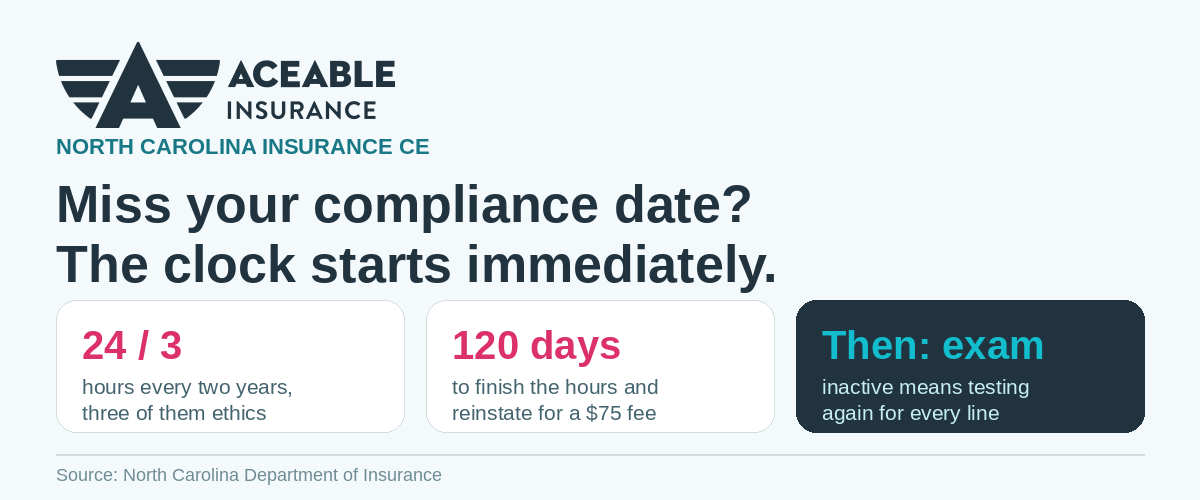
- You have four months. An expired North Carolina producer license can be reinstated within 120 days of your CE compliance date by finishing the missing hours and filing a reinstatement request with a $75 fee.
- Miss that window and the license goes inactive. Inactive is not a paperwork problem. It means qualifying for a new license and passing the state exam again for every line of authority you held.
- Reinstatement restores the license, not your book. Carrier appointments do not come back on their own, and you have to pursue re-appointment yourself.
North Carolina producer licenses do not expire on a calendar the way most states do. They expire when continuing education is not met by your compliance date, which falls on the last day of your birth month in your compliance year. The North Carolina Department of Insurance (NCDOI) then allows 120 days, or four months, to finish the hours and reinstate. Past that, the license is inactive and the only route back runs through the exam.
Expired or inactive? That difference decides everything
These two words get used interchangeably in agent forums, and they are not the same status. Sorting out which one applies to you is the first thing to do, because the two have completely different exits.
Expired means you missed your CE compliance date and are inside the 120-day recovery window. Your license is not producing, but the path back is administrative: finish the hours, pay the fee, file the form.
Inactive means the 120 days ran out. At that point, NCDOI treats you as a new applicant. You have to meet the state's current licensing requirements and pass the exam for each line of authority to be issued a new license.
To find out which one you are, check two records, not just one. Your license status appears in the NAIC State-Based Systems lookup. Your CE transcript, which shows exactly which hours posted and which categories they landed in, lives with Prometric, the Department's designated CE administrator. The transcript is the one that tells you the size of the gap. Our guide to NC CE requirementsContinuing Education What Are The Continuing Education Requirements For North Carolina Insurance Agents Resources covers what a compliant cycle looks like from the start.
How to reinstate an expired North Carolina insurance license, step by step
The order matters here more than agents expect. Reinstatement is not granted when you finish the coursework. It is granted when the credits appear on your transcript.
- Pull your CE transcript. Do not guess at the shortfall. Look at the actual record and count what posted.
- Identify which categories are short. North Carolina awards credit in three buckets: general, ethics, and flood. Being short on total hours is a different fix from being short on mandatory ethics or mandatory flood, and the Department treats a missing mandatory category as noncompliance even if your total looks fine.
- Complete the missing hours with an approved provider. Any approved North Carolina course counts toward the general portion regardless of the lines you hold, so you are not restricted to your own line of authority.
- Wait for the credits to post. Providers are required to report completions to Prometric within 15 business days. Mailing, processing, and error correction can stretch that, and the licensee handbook tells producers to follow up if credits have not appeared after 30 days.
- Submit the Request for Reinstatement of License Form to Prometric with the $75 fee. The form and current submission instructions are posted on the administrator's site.
- Verify the status change. Confirm in the license lookup that you are active again before you write anything new.
Realistically, a producer who already has the hours done can clear this in about one to two weeks. A producer starting from zero hours should plan on three to six weeks end to end, because the coursework, the posting lag and the reinstatement processing all stack.
What happens if the four-month window closes
This is the part worth being straight about. Once the 120 days pass, no amount of coursework reinstates the license. The Department requires you to qualify for a new license and pass the North Carolina exam for each line of authority you want back.
That is a real setback, and it is also survivable. Agents do it every year. If this is where you are, the useful move is to stop researching reinstatement and start on the exam, because the exam is now the only door. Our breakdown of NC exam prepPre License How Hard Is The North Carolina Insurance Exam And How Should You Prepare Resources explains what the test actually covers, and the NIPR applicationPre License How Do You Apply For Your North Carolina Insurance License Through Nipr Resources sequence is the same one you ran the first time. If it has been a while, the current licensing timelinePre License How Long Does It Take To Get An Insurance License In North Carolina Resources is shorter than most returning agents expect.
What reinstatement does not fix
Getting the license back is step one, not the finish line.
Appointments do not restore themselves. When your license expired, your carrier appointments went with it. The reinstatement acknowledgment says plainly that you must pursue re-appointment with the insurance companies yourself. Every carrier runs its own process and its own timeline. See how carrier appointmentsPre License How Carrier Appointments Work For North Carolina Insurance Agents Resources are filed so you know what you are asking each carrier to redo.
The gap in your servicing record is real. While you were expired, someone else was handling your clients' policy changes and claims questions. Reinstatement gives you authority back. It does not give you the relationship back.
Your compliance date does not move. Reinstating does not reset or extend your next compliance period. You land back on the same birth month clock, now with less runway.
Choose a State and Course
Why North Carolina insurance licenses expire in the first place
Almost nobody lets a license go on purpose. These are the five ways it actually happens.
The carryover assumption
North Carolina has generous carryover with no stated maximum, so excess hours roll forward. The trap is that excess ethics and flood credits carry forward as general credits only. No exceptions. An agent who banked six ethics hours last cycle still owes three fresh ethics hours this cycle, and the transcript will not warn them.
The flood requirement that is not about selling flood
Producers holding property or personal lines authority, and adjusters, owe three hours of flood training in their first compliance period and then every other compliance period after that, which works out to every four years. This applies whether or not you have ever written a flood policy. The Department's reasoning is that you need to understand what a property policy excludes. Agents who skip it because they do not sell flood are the single most common expiration story in the state.
The repeated course
You will not receive credit for the same course taken twice inside one compliance period. Agents who buy a bundle, then buy a second bundle from the same catalog to top up, often discover the overlap only when the credits post short.
The extension nobody requests in time
North Carolina does offer a 30-day extension, and the timing rule catches people going both directions. The request can be made no sooner than 30 days before your compliance period ends, and it must be received no later than the last day of that period, with a $75 fee. Too early is rejected. One day late is rejected. Once the license has expired, an extension is no longer available at all. Medical and active military waivers run on a separate track. Our overview of exemptions and extensions covers how those are evaluated.
Finishing on the deadline
Completion is not compliance. If the provider has not reported and Prometric has not posted, the Department sees an incomplete record on your compliance date, and the license expires on schedule.
What can slow down the reinstatement process in North Carolina
- Unposted credits. Reinstatement is not processed until the completed hours display on your transcript, so a slow provider is your bottleneck, not the Department.
- A mandatory category you did not know was short. Discovering a missing flood or ethics requirement mid-window turns a one-course fix into a three-course fix.
- Duplicate coursework. Hours that duplicate something already completed in the same period post at zero credit and do not close the gap.
- Name or address records that do not match. Credits report against your National Producer Number, and mismatched records send hours to the wrong place.
- Waiting on carriers afterward. The license may reinstate quickly while re-appointment adds weeks before you can actually write business again.
How North Carolina compares to other states
Most states run licenses on a renewal application with a fee, and a late renewal is a matter of paying the fine. North Carolina works differently. Producer licenses here are perpetual, meaning there is no separate renewal application, and continuing education is the only thing keeping the license in good standing. That makes CE unusually high stakes.
The consequence structure is also stricter than average. States that fine per missing hour give you a checkbook solution. North Carolina gives you a 120-day clock, and when it runs out the remedy is the exam. Non-resident producers, by contrast, owe North Carolina no CE at all and are verified through the producer database, which is why nonresident reciprocity confuses so many agents who move here and suddenly owe hours for the first time.
Full requirements, current forms and the reinstatement instructions are published by the NCDOI, and the transcript lookup and forms are hosted by the CE administrator.
How to make sure this never happens again
The agents who never see an expiration notice all do the same three things. They put the compliance date on a calendar the day it resets, not the month it arrives. They complete ethics and flood every period as a rule, rather than trusting carryover to cover a mandatory category. And they finish 60 days out, so the posting lag lands inside the window instead of outside it.
That is the whole system. One date, two mandatory categories, and a 60-day buffer.
Knock Out CE From Your Phone
Mobile, self-paced, and built to fit between appointments instead of blocking a weekend.