
How Hard is the North Carolina Insurance Exam, and How Should You Prepare?

North Carolina Keeps Growing. So Should You.
Every new home, car, and business in the state needs an agent, so become one.
Quick Answer
- It is moderately hard: each major line exam gives you 1 hour and 15 minutes for 55 scored questions, and about a quarter of them test North Carolina insurance law.
- You need a scaled score of 70 to pass: that is not the same as getting 70 percent of the questions right, because raw scores are converted to a 0 to 100 scale.
- Preparation decides it: study to the state content outline, practice applying concepts to real situations, and book your exam once timed practice scores sit comfortably above the pass line.
How Is the North Carolina Insurance Exam Set Up?
The North Carolina Department of InsuranceInsurance Producer And Adjuster Licensing Become Insurance Producer Or Adjuster Licensees (NCDOI) licenses insurance producers, and Pearson VUE delivers the licensing exams. You take a separate exam for each line of authority you want to hold.
- Life, Accident and Health or Sickness, Property, Casualty: 55 scored questions plus up to 5 unscored pretest questions, with 1 hour and 15 minutes per exam.
- Personal Lines: 80 scored questions plus up to 16 unscored pretest questions, with 1 hour and 45 minutes.
- Format: four option multiple choice, with a general section and a North Carolina section that are scored together as one exam.
- Passing standard: a scaled score of 70 on a 0 to 100 scale.
- Results: you leave the test center with an official score report marked pass or fail.
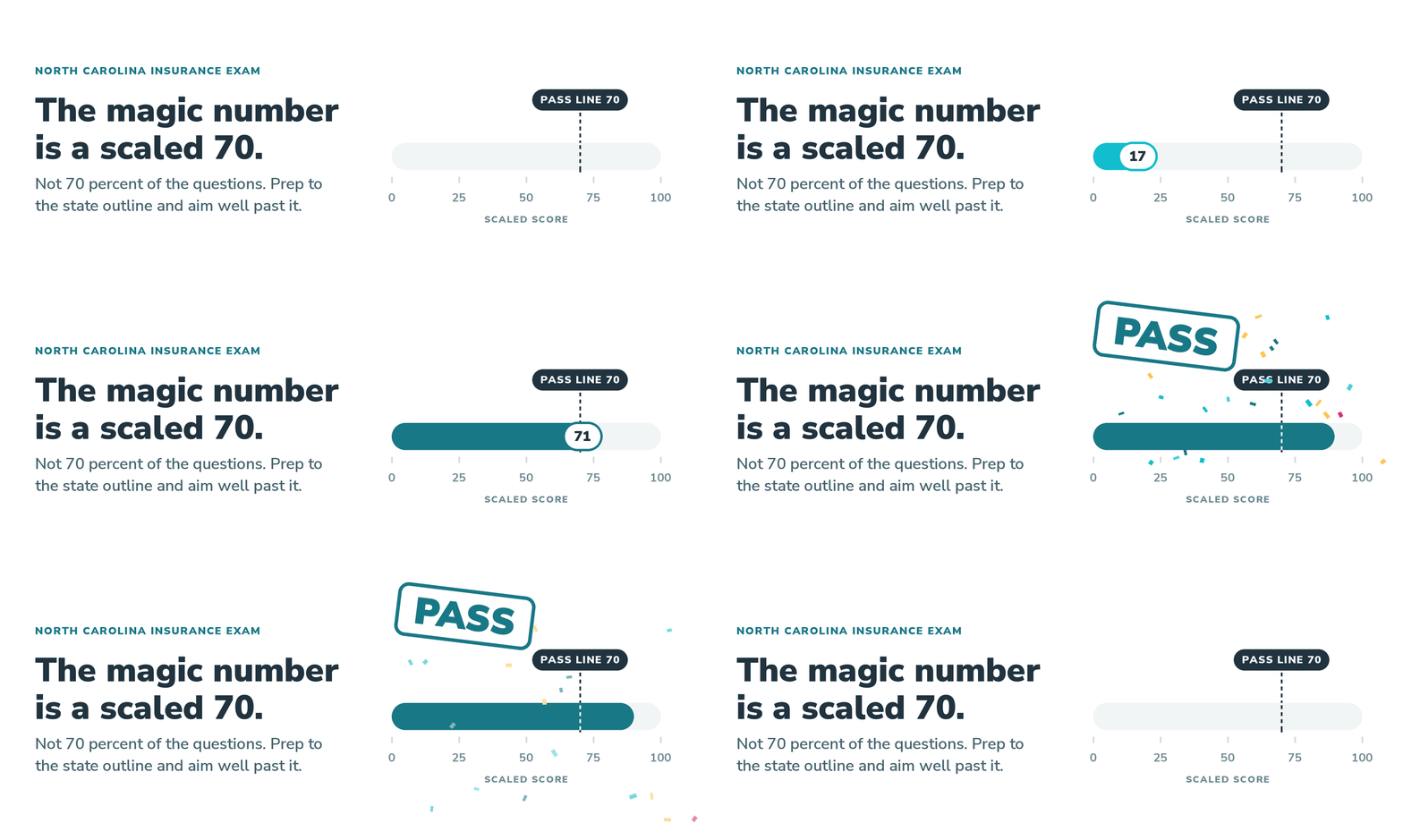
The scaled score is the detail most first time test takers miss. The candidate handbookCompany Licensing Nc Insurance Licensing Examination Candidate Guide Open Documents explains that your reported score is neither the number nor the percentage of questions you answered correctly. Each version of the exam is adjusted for difficulty, so the smart move is to aim well past the line instead of counting how many questions you can afford to miss.
How Does North Carolina Compare to Other States?
Several states that test through PSI, including PennsylvaniaPre License What Score Do You Need To Pass The Pennsylvania Insurance Exam Resources, ArizonaPre License Whats The Best Way To Pass The Arizona Insurance Exam On Your First Try Resources and WashingtonPre License How To Pass The Washington Insurance Exam On Your First Try Resources, report a simple 70 percent passing score. North Carolina's major line exams are also shorter than the 100 question single line exams in Pennsylvania and Arizona. MissouriPre License What To Expect On The Missouri Insurance Exam Resources is a closer match, since it also tests through Pearson VUE.
Where Do First Time Test Takers Lose Points?
The handbook is direct about this: people who memorize catch phrases and definitions without learning how to apply them find many state exam questions difficult. Here is where that shows up most.
- North Carolina law. State statutes and regulations account for 14 of 55 scored questions on the Life and Accident and Health exams, 13 on Property, 15 on Casualty, and 24 of 80 on Personal Lines. Licensing rules, unfair trade practices and continuing education rules all appear.
- Heavy coverage sections. Homeowners policies alone make up 12 scored questions on the Property exam, and personal coverages like the personal auto policy make up 18 on Casualty.
- Policy provisions. Grace periods, reinstatement, nonforfeiture options and beneficiary rules reward precise knowledge on Life, and mandatory and optional provisions do the same on Accident and Health.
- Application questions. Many questions describe a situation and ask what happens next, so you need to use a concept, not just recognize the term.
- NOT and EXCEPT questions. The exam capitalizes and bolds these words to warn you, but rushing past them is still one of the easiest ways to drop points.
- The clock. Seventy five minutes for up to 60 questions works out to about a minute and fifteen seconds each, so long scenario questions can eat your time.
Choose a State and Course
Know Your Worth, Mountains to Coast.
The salary guide shows what agents earn across North Carolina's markets.

How Long Should You Study for the North Carolina Insurance Exam?
Most people need two to six weeks, depending on how many lines they are taking and how much time they can give each day.
- One line, such as Life or Property: fastest is about two weeks of daily study, and three to four weeks is typical.
- Two lines, such as Life plus Accident and Health: fastest is about four weeks, and five to six weeks is typical, since you sit two separate exams.
- Personal Lines: plan on three to four weeks, because it blends homeowners, dwelling, flood and personal auto into one longer exam.
Whatever your timeline, work in this order:
- Read the content outline first. The handbook calls it the best blueprint for choosing what to study, because every exam question is written from it.
- Take a diagnostic practice exam early. It shows you which sections need the most work before you spend time on the ones you already know.
- Study by weight. Give the most time to the biggest sections, like types of individual life insurance, which carries 17 scored questions on the Life exam.
- Drill North Carolina law on its own. General insurance knowledge will not carry you through the state section.
- Finish with timed practice exams. Practice at 75 minutes so the real clock feels familiar.
For more on building a routine that sticks, see our guide on how to study.
How Does Aceable Help You Prepare for the North Carolina Exam?
Aceable Insurance's North Carolina exam prep is built to the state content outline, so every lesson maps to what the exam actually tests. Lessons are short enough to finish on your phone between everything else, practice questions are written in exam style, and full practice exams show you where you stand before you book. North Carolina exam prep also comes with the Aceable Pass Guarantee.
How Do You Schedule the North Carolina Insurance Exam?
- Apply through NIPR first. North Carolina requires you to complete your license application and pay the fees before you can schedule an exam.
- Wait for your Pearson VUE authorization email. It includes your reserved National Producer Number and your eligibility dates. Your application is valid for six months, and you must pass before the end date.
- Book online or by phone at least 24 hours ahead. Walk in testing is not available.
- Bring two forms of current ID. One must be a government issued photo ID with your signature, and the name on both must exactly match your registration.
- Arrive 30 minutes early. A simple function calculator is allowed, and everything else stays in a locker or your car.
- Complete your fingerprints. Major line applicants need Live Scan electronic fingerprints, taken at a local law enforcement office with the forms from your NIPR email.
Need a different date? Change or cancel at least 48 hours before your appointment to keep your fee. If you do not pass, you can schedule a retake after 24 hours, and your score report will show the areas that need work.
What Can Slow Down the Licensing Process in North Carolina?
- Trying to book before your Pearson VUE authorization email arrives.
- A name on your ID that does not exactly match your exam registration.
- An expired ID, since Pearson VUE does not honor grace periods.
- Late fingerprints or missing documents for any yes answers on your application.
- Letting your six month eligibility window close before you pass.
Once your license is issued, you still need an appointment from at least one insurance company before you can sell its products.
Frequently Asked Questions
What score do you need to pass the North Carolina insurance exam?
You need a scaled score of 70 on a 0 to 100 scale. It is not the same as answering 70 percent of the questions correctly, and numeric scores are only shown to candidates who do not pass.
How many questions are on the North Carolina insurance exam?
The Life, Accident and Health, Property and Casualty exams each have 55 scored questions plus up to 5 unscored pretest questions. Personal Lines has 80 scored questions plus up to 16 pretest questions.
Can you retake the North Carolina insurance exam?
Yes. You must wait 24 hours before scheduling a retake, and you need to pass before your application's six month eligibility period ends.
Ready to Take On the North Carolina Exam?
This exam rewards people who understand the material, not people who memorized it the night before. That is exactly what good prep builds. Start NC exam prep built to the state outline, practice until your scores clear the line with room to spare, and walk in knowing you belong there.
Be the Agent Your Carolina Neighbors Call.
Get licensed with prep built for North Carolina's exam, not a one-size-fits-all course.