
What Do You Need to Renew Your Ohio Insurance License?

Ohio runs on insurance, keep running.
From Columbus to Cleveland, Buckeye State agents trust modern, mobile CE that fits between client calls.
Quick Answer
- The short answer: complete 24 CE hours, including 3 ethics, then file a renewal application. Renewal is not automatic.
- You can bank a little ahead: Ohio lets you carry over up to 12 excess hours, though only as general credit.
- Your window opens early: you can renew up to 90 days before your expiration date.
Plenty of Ohio agents assume renewal happens on its own once the hours are done. It does not. Ohio is an apply to renew state, which means finishing your continuing education is only half the job. We have helped many producers untangle the difference between completing CE and actually submitting the renewal, and the gap between those two steps is where licenses lapse.
Everything below reflects the rules set by the Ohio Department of Insurance, the agency that administers producer licensing and CE compliance statewide. Here is what you owe, the renewal steps in order, and the details that trip people up.
What do you need to renew an Ohio insurance license?
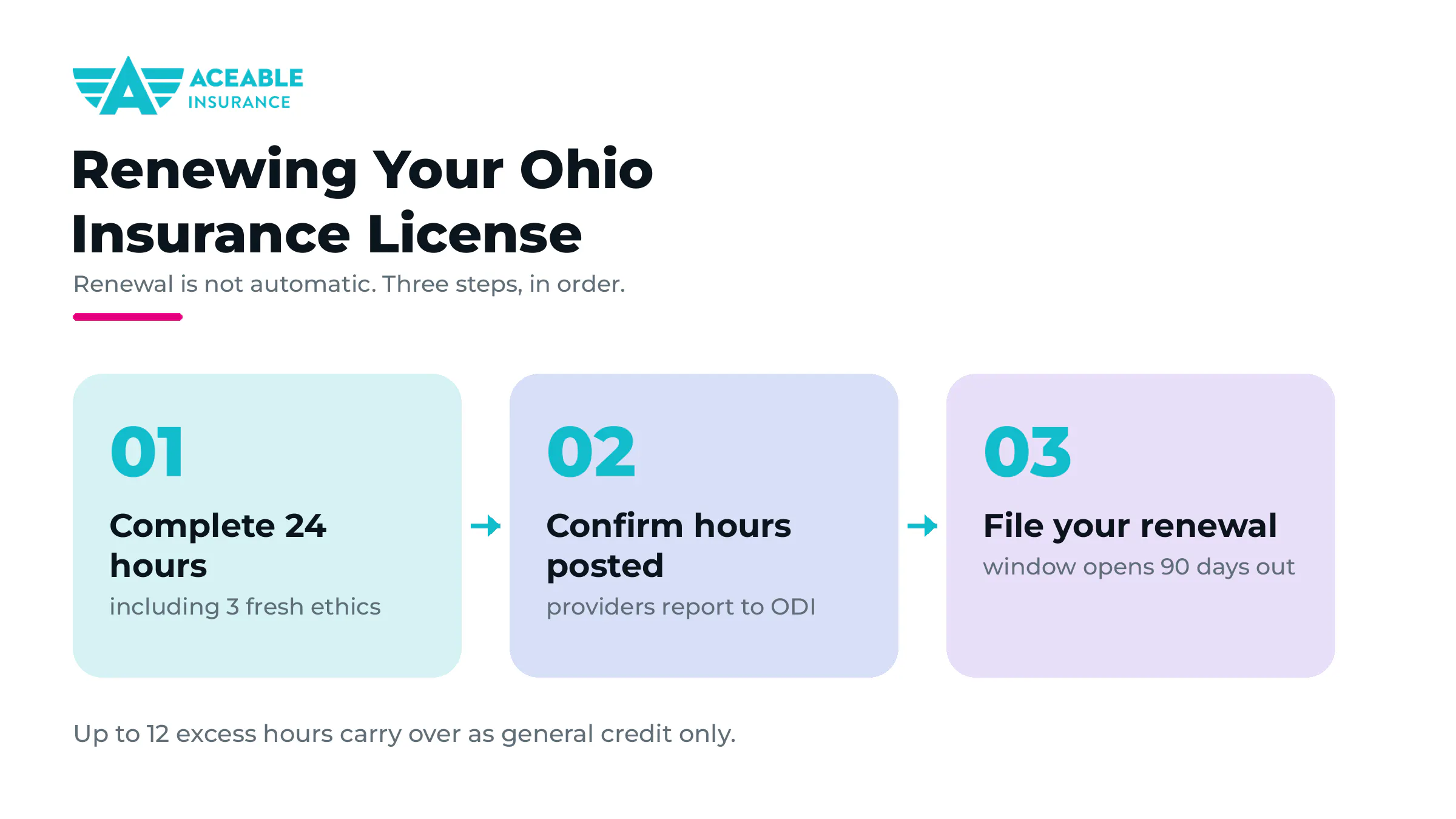
Three things, in order. Complete your 24 CE hours including ethics. Confirm the hours have posted to your record. Then file a renewal application and pay the fee. The renewal window opens 90 days before your expiration date, and because renewal is not automatic, nothing happens until you submit that application.
That apply to renew rule is the single most important thing to internalize about Ohio. Your credits can be fully posted, your compliance can be perfect, and your license can still expire if you never file. The state will not renew you on your behalf. Building the renewal submission into your calendar as a separate task from your coursework is the best protection against an avoidable lapse.
Why does the apply to renew rule matter so much?
Because finishing your hours can create a false sense of completion. Many agents treat the last course as the finish line, then move on, never realizing the application is still sitting unsubmitted. New agents who are still getting licensedPre License How To Get An Insurance License In Ohio Resources can set the right habit from the start by separating "CE done" from "renewal filed" in their own tracking.
How many CE hours does Ohio require?
Major Lines producers complete 24 total CE hours every two years, and 3 of those hours must be ethics. Holding multiple lines of authority does not increase the total. Whether you carry life, health, property, and casualty all at once or just one line, the requirement stays at 24 hours. The remaining 21 hours can be any approved subject, since Ohio CE is non license type specific.
Are any license types different?
Yes. Title only producers carry a reduced requirement of roughly 12 hours, most of it title specific, and surety bail producers have their own smaller hour structure. Most agents reading this hold Major Lines and owe the standard 24 hours. If you are weighing which lines to add, our guide to insurance career pathsPre License Your Complete Guide To Insurance Types And Career Opportunities Resources can help you map the decision.
When does an Ohio insurance license expire?
Your license expires on the last day of your birth month, every two years, aligned to when your license was first issued. For example, a producer born in April sees the license expire on April 30 of the renewal year. The Ohio Department of Insurance recommends completing all CE well in advance so a reporting delay never costs you the renewal.
What happens if I renew late?
Ohio offers a one month late period after your expiration date, during which your license stays active while you submit the application and pay a late fee. Miss that one month window and the license is suspended, and your carrier appointments terminate with it. A suspended license can be reinstated within one year by completing all CE, applying, and paying the fees. Let a full year pass and you start over as a new applicant. The grace period is forgiving, but it is not a substitute for planning.
Choose a State and Course
Ready to level up your insurance game? Get the expert guidance and resources you need to go pro.
How do you renew your Ohio insurance license, step by step?
- Find your deadline. Your license expires the last day of your birth month every two years. Confirm the exact date so you can work backward.
- Complete 24 hours, including 3 fresh ethics. Use providers approved by the Ohio Department of Insurance. Ethics must be completed every cycle and cannot be satisfied by carried over credit.
- Finish any specialty training. Long term care, annuity, and flood requirements apply if you sell those products.
- Confirm your hours posted. Providers report your completion to the state. Verify the credits appear on your record before moving on.
- File your renewal application. The window opens 90 days before expiration. Submit the application and pay the fee. Renewal is not automatic, so this step is mandatory.
Can you carry over CE hours in Ohio?
Yes, up to 12 excess hours carry over to the next renewal period, but only as general credit. That distinction matters: surplus ethics hours roll forward as general hours and will not satisfy the next cycle's ethics requirement. You must complete fresh ethics coursework every single cycle. Carryover credits post automatically to your record after you renew and appear on your transcript as carryover.
What about specialty training carryover?
Specialty training hours follow the same logic. Any excess counts only as general credit going forward, never toward the specialty or ethics obligation it originally fulfilled. Plan to repeat ethics and any required specialty training each period rather than relying on banked hours. And a duplicate course taken twice in one period will not generate carryover credit.
What special training does Ohio require?
Ohio adds product specific training for agents who sell certain coverages, on top of the standard hours.
Long term care training
Long term care producers complete an initial 8 hour course before selling any long term care product, then 4 hours of ongoing training every 24 months. The ongoing long term care hours do not count toward your general 24 hour total, so budget for them separately.
Annuity and flood training
Anyone selling annuities completes a one time 4 hour Annuity Best Interest course before their first sale, and these credits do count toward the 24 hour requirement. Producers who write National Flood Insurance Program policies complete a one time 3 hour flood course during their first compliance period. These requirements gate your ability to sell those products, so completing them early keeps your options open as you grow earning potential.
How do you complete and report Ohio CE?
You can complete approved courses online or through webinars. Online coursework is self paced, and you work through review questions as you go rather than sitting a single proctored exam, with no monitor required. Webinar credit is based on attendance and participation for the full session. Your provider reports your completion to the Ohio Department of Insurance, typically within a couple of weeks, and once those hours post, you file your renewal through the state's online process. Staying organized here is part of building the career habits that keep a license clean.
Are non resident producers exempt?
Generally, yes. Non residents who stay compliant with their home state CE are usually exempt from Ohio specific continuing education, and Ohio honors the home state requirement under reciprocity. Producers holding only a limited authority license, and those granted inactive status, are also outside the standard requirement.
What can slow down your Ohio renewal?
- Forgetting to apply. Renewal is not automatic. Completed hours do not renew your license on their own.
- Reusing old ethics. Carried over ethics hours count only as general credit, so you owe 3 fresh ethics hours every cycle.
- Cutting it close. Hours must post before you can renew. Finishing days before your deadline risks a lapse if reporting lags.
- Missing specialty training. Long term care, annuity, and flood requirements can block product sales even when your general hours are done.
- Letting the 90 day window pass unused. The early window exists to give you breathing room. Waiting until the final week removes it.
How does Ohio compare to other states?
Ohio's 24 hour total with 3 ethics is the national norm, and its 12 hour carryover allowance matches states like Illinois and Michigan. Where Ohio asks more of you is the apply to renew step, which some states automate. States such as North Carolina tie the license itself to CE compliance without a separate application, while Ohio requires you to file every cycle. Treat the renewal application as a distinct task from your coursework and Ohio becomes one of the more predictable states to stay compliant in. For agents expanding beyond Ohio, knowing the Ohio exam helps you compare each state's rules cleanly.
Ohio insurance CE: frequently asked questions
How many CE hours does Ohio require?
Producers complete 24 hours every two years, including 3 hours of ethics.
What do you need to renew an insurance license in Ohio?
Complete your 24 CE hours including ethics, then file a renewal application. Renewal is not automatic and the window opens 90 days before your expiration date.
Can I carry over CE hours in Ohio?
Yes, up to 12 excess hours carry over as general credit. Ethics hours must be completed fresh each cycle.
Do Ohio CE courses require a monitor?
No. Online courses are self paced with review questions, and no exam monitor is required.
When does my Ohio insurance license expire?
On the last day of your birth month, every two years.
Keep your Ohio license active without the stress
Renewing in Ohio comes down to a simple sequence: 24 hours, 3 of them fresh ethics, posted credits, then a filed application before your birth month deadline. Add the carryover and specialty rules and you have the full picture. If you are adding a new line of authority to sell more, our Ohio pre licensing courses get you exam ready, and Aceable Insurance is building a modern CE experience designed to make the renewal side just as painless. Join the Ohio CE waitlist to get notified at launch.
Last reviewed by the Aceable Insurance compliance content team against the Ohio Department of Insurance continuing education and renewal requirements.
Source: Ohio Department of Insurance.

Finish your Ohio CE today, not on deadline day.
Ohio renewal isn't automatic, so we walk you through completing your 24 hours and filing before your birth month closes. All in one place, all on your phone.