
Washington Insurance Continuing Education Requirements

Washington renewal lands on your birth month.
From Seattle tech offices to Spokane Main Street, Evergreen State agents keep selling without the dusty textbook. Knock out every hour in one place.
Quick Answer:
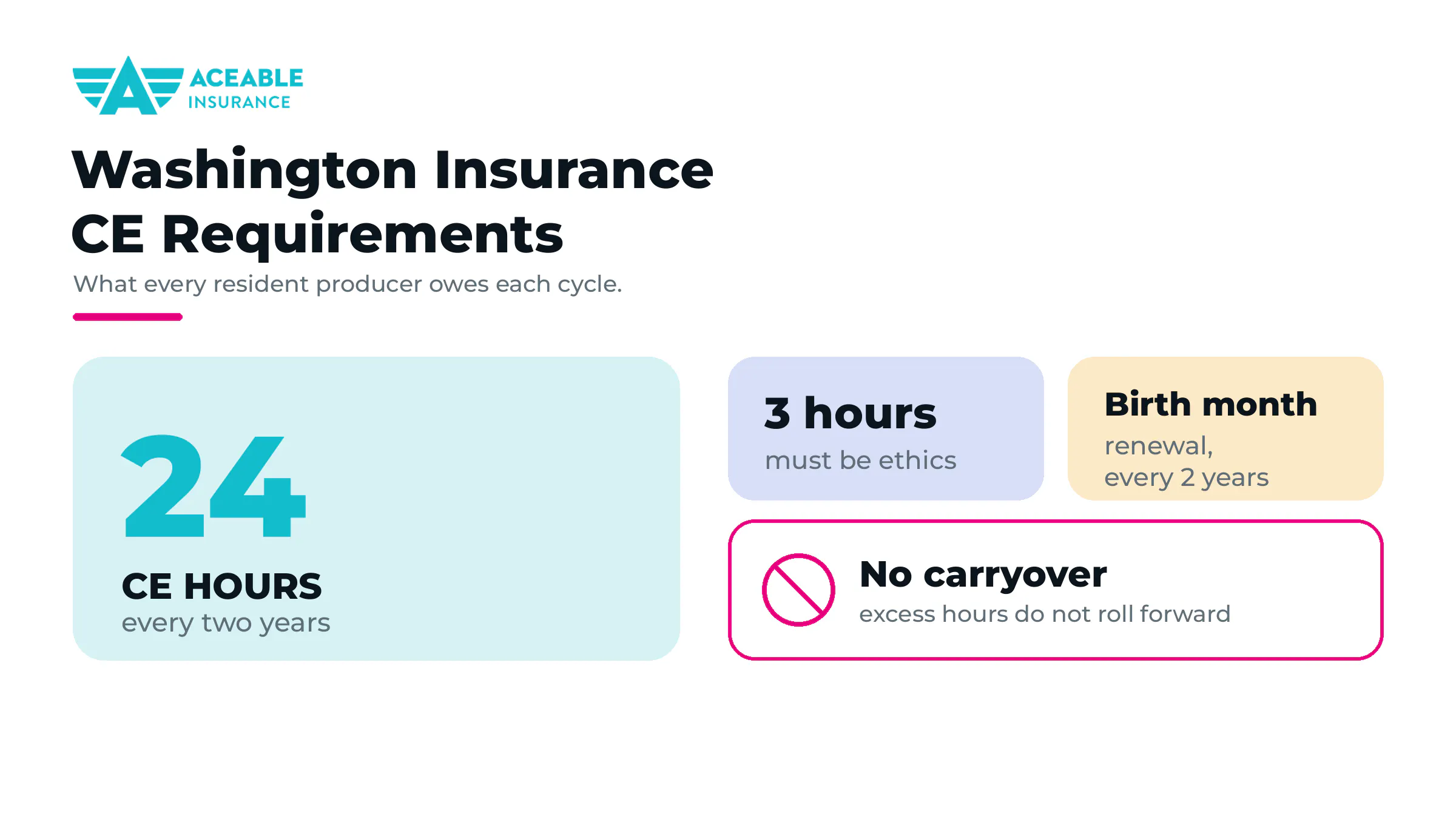
- The short answer: resident producers complete 24 CE hours every two years, and 3 of those hours must be ethics.
- Plan each cycle on its own: Washington does not let excess credits carry over, so you start fresh every renewal.
- Your deadline is personal: licenses renew on the last day of your birth month, every two years.
If you have already passed the exam and built your book, you know the licensing math does not stop at day one. Keeping a Washington producer license active means meeting a continuing education requirement on a clock tied to your own birthday. We have walked hundreds of new agents through this same cycle, and the part that trips people up is rarely the hour count. It is the no carryover rule and the specialty training that sits on top of the standard hours.
The requirements below are drawn directly from the Washington Office of the Insurance Commissioner, the agency that oversees every resident producer license in the state. Here is exactly what you owe, when it is due, the steps to renew, and what tends to slow people down.
How many CE hours does Washington require for license renewal?
Every resident producer licensed in life, disability, property, casualty, or personal lines completes 24 total CE credit hours in each two year renewal period. Three of those 24 hours must be certified ethics credits. The other 21 hours can come from any approved subject, which gives you real freedom in how you build your cycle.
That structure is worth pausing on. Washington does not split your hours into rigid line specific buckets the way some states do. A producer who writes mostly auto and home can still satisfy the bulk of the requirement with courses on life products, disability income, or emerging risk topics. The only fixed anchor is the 3 hour ethics block, which the Office of the Insurance Commissioner tracks as its own category and will not let general hours backfill.
Do resident adjusters have the same requirement?
Yes. Resident adjusters, along with non resident adjusters who name Washington as their designated home state, also complete 24 hours including 3 hours of ethics each renewal period. The structure mirrors the producer requirement, so adjusters can plan their cycle the same way producers do.
Do my courses have to match my license type?
No, and this is one of the friendlier features of the Washington system. Any course from an approved provider counts toward your total, regardless of the specific lines of authority you hold. A property and casualty producer can satisfy hours with a life or health course. The state's guidance does suggest weighting your coursework toward the lines you actually write, simply because it keeps you sharper for clients, but it is a recommendation rather than a rule. Agents who are still getting licensedPre License How To Get Your Insurance License In Washington Resources will not deal with CE yet, but it pays to know the renewal rules early.
When does a Washington insurance license expire?
Your license renews on the last day of your birth month, every two years. Your first renewal lands two years after your license was issued, aligned to your birth month, and every renewal after that follows the same two year rhythm. The Office of the Insurance Commissioner sends a renewal notice ahead of your deadline, typically a couple of months out, but the responsibility to track the date is yours. Treating that notice as a backup rather than your primary reminder is the safer habit.
How do I find my renewal date?
Log in to your individual account with the Office of the Insurance Commissioner and open your education history. That record produces a document charting your completed hours and your compliance window, so you can see at a glance how many hours you still owe and when they are due. Checking it well before your deadline is the simplest way to avoid a last minute scramble, and it is a habit worth building alongside the other habits successful agentsPre License Tips Becoming A Successful Insurance Agent Resources rely on.
How do you renew your Washington insurance license, step by step?
Most competitor pages list the hours and stop there. The renewal itself is a short sequence, and knowing it end to end is what keeps a clean license clean.
- Confirm your deadline. Check your education history in your online account so you know your exact expiration date and remaining hours.
- Complete 24 approved hours, including 3 ethics. Use providers approved by the Office of the Insurance Commissioner. The approved provider list updates twice a year, so verify your provider's current standing before you enroll.
- Finish any required specialty training. If you sell long term care, annuities, or flood, complete those courses as well. They sit on top of your 24 hours.
- Let your provider report. The provider reports your credits to the state within 10 days of completion. Build that window into your timeline.
- Confirm your hours posted, then renew. Once your credits appear in your education history, renew your license online. Keep every certificate for three years in case of an audit.
Does Washington let CE hours carry over?
No. Washington does not allow excess credits to roll into the next renewal cycle. If you complete more than 24 hours, the surplus is simply lost when the cycle closes. This makes Washington stricter than states like Ohio or Georgia, where a portion of extra hours can carry forward. The practical takeaway is to plan each two year cycle as a standalone target rather than banking ahead.
How long are my completion certificates valid?
A certificate of completion is valid for 24 months from the date you finish the course. The provider reports your credits to the state within 10 days of completion, and you should keep each certificate in your own files for three years in case of an audit. If you are reinstating a lapsed license, your courses must have been completed within the 24 months before your reinstatement application.
Can I repeat a course for credit?
You cannot earn credit for the same course twice within a single renewal cycle, so match each unit you take to a distinct course number. Washington did relax the older multi year repeat restriction, so a course you took in a prior cycle can generally be taken again in a new one, with one exception: if your last renewal was late and you completed the course after your expiration date, repeating it for the next cycle will not earn credit.
Choose a State and Course
Stay updated with Washington industry news, learn about life as an insurance agent, and get exclusive offers on our course!
What special training does Washington require?
Beyond the standard 24 hours, Washington layers in product specific training for agents who sell certain coverages. These requirements stand on their own and do not replace your general hours.
Long term care training
Producers selling long term care insurance complete an initial 8 hour course before their first long term care sale, then a 4 hour refresher every 24 months to stay compliant. There is also a newer rule, effective May 1, 2026, requiring a 1 hour course before submitting new business for long term care supplemental policies, which is a detail many competitor pages have not yet added.
Annuity and flood training
Anyone selling annuity products completes a one time 4 hour Annuity Best Interest training before their first annuity sale. Producers who write federal flood policies complete a one time 3 hour course built around National Flood Insurance Program standards. Both are separate from and in addition to your 24 general hours. Deciding which lines to carry shapes which of these you will need, so it helps to understand your insurance career options early.
How do I complete and report my Washington CE?
You can complete approved courses through self study, online, or in a classroom. There is no mandatory classroom component, so the format is yours to choose. Self study final exams are open book and do not require a monitor, and most providers let you keep the course materials as a reference. Once you finish, the provider reports your credits to the Office of the Insurance Commissioner within 10 days, and you renew online once your hours post. If your license has lapsed and you are weighing a fresh start, our overview of Washington exam preparation covers the path back.
Are non resident producers exempt?
Yes. Non resident producers in good standing with their home state are not required to meet Washington CE, provided their home state requirements are similar to Washington law. The same logic extends to the specialty training for long term care, annuities, and flood: if you met a comparable requirement in your home state, Washington generally treats it as satisfied. The state may verify a non resident's standing before renewal.
What can slow down your Washington CE renewal?
- Assuming credits carry over. They do not. Surplus hours from a prior cycle will not reduce what you owe this time.
- Skipping fresh ethics. The 3 ethics hours must be completed within the current cycle and are tracked separately from general hours.
- Forgetting specialty training. Long term care, annuity, and flood requirements sit on top of the 24 hours and can block sales if missed.
- Late provider reporting. Providers have up to 10 days to report. Finishing your hours days before your deadline risks a lapse if the credits have not posted.
- Losing certificates. Keep every certificate for three years. Missing documentation complicates an audit or a reinstatement.
How does Washington compare to other states?
Washington's 24 hour total with 3 ethics hours is the most common standard in the country, so the volume itself is unremarkable. What sets the state apart is the no carryover rule paired with no mandatory classroom hours. You get full flexibility on format but no ability to bank ahead, which is the reverse of states that allow carryover but restrict how ethics can be delivered. New Jersey, for instance, requires 12 of its 24 hours to be classroom or classroom equivalent, while Washington imposes no such format rule. For agents holding licenses in more than one state, understanding the Washington rules helps you keep each state's clock straight. And if you are adding a new line of authority to expand what you can sell, our Washington pre licensing courses get you exam ready for that line.
Washington insurance CE: frequently asked questions
How many CE hours does Washington require for insurance license renewal?
Resident producers complete 24 credit hours every two years, including 3 hours of ethics.
Does Washington allow CE hours to carry over?
No. Washington does not allow excess credits to carry into the next renewal cycle, so plan each cycle independently.
When does my Washington insurance license expire?
Licenses renew on the last day of your birth month every two years.
Do my CE courses have to match my license type?
No. Any course from an approved provider counts toward the requirement regardless of your specific lines of authority.
Do non resident producers need Washington CE?
No. Non residents in good standing with their home state are not required to meet Washington CE.
Keep your Washington license moving forward
Continuing education is the one recurring requirement standing between you and an uninterrupted career, and in Washington it is genuinely manageable once you know the rules: 24 hours, 3 of them ethics, no carryover, due on your birth month. Track your date, complete your specialty training early, and confirm your credits posted before you renew. Aceable Insurance is building a modern, mobile first CE experience designed for Washington producers who would rather spend their time with clients than with a clunky course platform. Join the Washington CE waitlist to get notified the moment it launches.
Last reviewed by the Aceable Insurance compliance content team against the Washington Office of the Insurance Commissioner continuing education requirements.

Finish your Washington CE Today
All 24 hours with your 3 ethics included, and since Washington gives you no carryover, we help you finish each cycle clean. Renew on your phone, on your schedule.