

The Degree-Free Insurance Career Report
A data-driven look at the rise of skills-first careers, stackable credentials, and a generation skipping the debt.
Research conducted by Aceable in partnership with Kickstand
Key Findings
- Success is money, not promotions. 81% of Gen Z say success means financial independence. 60% say it means owning their time. Only 27% say it means climbing the ladder.
- The four-year degree is no longer the default. 73% say college costs more than it pays off. Among graduates, only 33% got a first job that actually used their degree.
- Career programs are winning. 46% have already finished a licensure, certification, or vocational program. 63% expect non-degree paths to drive how they earn over the next five years.
- Flexibility beats pay. 62% would trade a raise for a four-day week. 67% would pick contract work over full-time if it bought them control. 86% measure success by control over their time, not by title.
- Side hustles are mainstream. 78% have one. 42% of those plan to turn it into a real business within five years.
- AI cuts both ways. 81% say AI is shrinking entry-level openings for graduates. But 73% say AI makes it easier to launch their own thing.
How Gen Z Defines Success in 2025
Ask Gen Z what success looks like and they will not describe a corner office. They will describe a bank account that covers their needs and a calendar they get to control.
Financial Independence Tops the List of Gen Z Success Markers
81% define success as financial independence. Ownership of their time comes in second at 60%, followed by continuous learning at 56% and meaningful work at 55%. Women were 20% more likely than men to put meaningful work on that list.
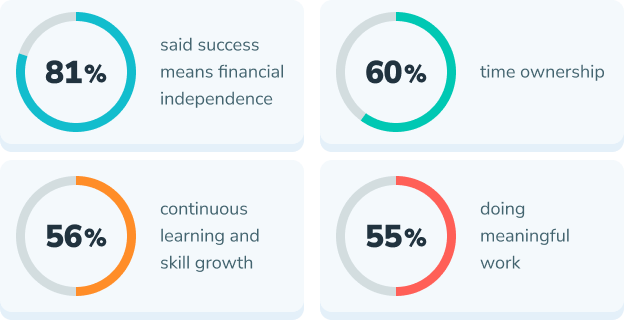
The traditional markers? They're an afterthought. Only 27% said success means climbing the career ladder. Just 21% tied it to recognition from peers or leadership.
81% of Gen Z define success as financial independence. Only 27% define it as climbing the career ladder.
Passion Drives Gen Z Career Decisions More Than Pay
What pulls Gen Z toward a particular industry? Personal interest, mostly. 65% said their passions drive their career choices, well ahead of earnings potential (49%) and job stability (43%). Technology leads as the top industry of interest at 20%, followed by healthcare (16%), entrepreneurship (11%), and financial services and insurance (10%). Men were 80% more likely than women to express interest in insurance, while Florida respondents were 127% more likely than average to want to start their own business.
The Four-Year Degree Has Lost Its Monopoly
Gen Z hasn't written off college. They've just demoted it. 63% of respondents called a four-year degree helpful but not essential. Another 13% said it's rarely worth the cost at all.
Why Gen Z No Longer Sees College as the Default Path
The skepticism didn't appear out of nowhere. It came from watching what happens after graduation. Only 30% of Gen Z college grads entered college with both their major and intended career figured out. Among graduates overall, only 33% landed a first job that actually used their degree. Florida grads fared the worst, at 65% less likely than average to report a degree-aligned first job.

73% of Gen Z say the cost of college no longer matches its career payoff. Women were 18% more likely than men to hold this view.
How AI Is Reshaping the Entry-Level Job Market
AI sharpens the picture. 81% of respondents agree that AI and automation are shrinking entry-level opportunities for college graduates. Whether the labor data ultimately bears this out is almost beside the point. A generation that believes the on-ramp is narrowing will start looking for other on-ramps, and the data suggests they already are. For anyone considering insurance specifically, the entry point looks dramatically different: licensing only requires a high school diploma and you can be licensed and earning in a matter of weeks, not years.
Why Career Programs Are the New Default for Gen Z
As the degree shrinks, something else is filling the space. Licensure. Certification. Apprenticeship. Vocational training. None of this is a backup plan anymore for most of Gen Z. It is the plan.
Nearly 9 in 10 Gen Z Adults Are in or Considering a Career Program
46% of Gen Z respondents have already completed a career program. Another 31% want to. 12% are enrolled right now. That's 89% of Gen Z either in, considering, or already done with a non-degree path. The motivators are practical: clearer job placement (44%), interest in lifelong learning (41%), and faster time to income (39%). Self-employed respondents were 21% more likely than average to cite speed, which tracks with how independent workers think about getting paid.
Stackable Credentials Are Replacing the One-Time Degree
Gen Z is not treating these credentials as one-and-done. One in three career program graduates and prospects say they're very likely to add more credentials over time, with the expected refresh cycle every three to four years. 83% said the ideal education model is a hybrid path stacking short credentials with select coursework. This is exactly the model insurance follows: get your initial license, then add specializations, then layer in continuing education to keep it active. For anyone wondering whether the math works, licensing typically runs $200 to $500 and most people are earning within weeks of passing.
AI Skills Are Now a Required Layer on Top of Credentials
Future-proofing instincts also show up in how Gen Z plans to layer AI onto their credentials. 62% of career program graduates and prospects are pairing their program with AI skills training, or already have. 68% say a future-proof career requires both.
What's Holding Gen Z Back From Career Programs, and What Would Help
The barriers? Practical ones. Upfront cost (57%) leads, time commitment (50%) is right behind, and unclear career outcomes (34%) comes third. But here's the part that matters: among Gen Z who finished a program, 81% said the return on investment met or exceeded what they expected. And 66% said flexible or online scheduling would make them more likely to enroll, which is why online and self-paced courses have become standard.
Regional Signal: Texas.
Texas Gen Z were 43% more likely than average to say they are very confident in their ability to build a sustainable career without a college degree. That pattern shows up nationwide, but it's sharper in Texas than anywhere else in the sample.
How Gen Z Is Designing Work Around Life, Not the Other Way Around
Credentials are how Gen Z gets in. But once they're in, they want a different deal than the one their parents took. They're not asking for more money inside the same structure. They want a different structure.
Time Control Outranks Job Title for 86% of Gen Z
86% of Gen Z respondents want to measure success by control over their time, not by their job title. Only 16% pointed to title or prestige as one of the most important things about their ideal job. That's not close. The top three job priorities? Flexible hours (63%), remote or hybrid work (53%), and purposeful work (52%).
Gen Z Would Trade a Raise for a Four-Day Work Week
And they're putting their money where their mouth is. 62% would trade a raise for a four-day work week. 67% would pick contract work over full-time if it gave them control over where and when they work. Taking on the volatility of contract employment in exchange for more control is a real change from how their parents thought about job stability, and it's a big reason why independent insurance agent roles appeal to this generation. Commission-based work with flexible hours and unlimited earning potential maps almost perfectly to what Gen Z says they want.
Why Flexible Hours Matter So Much to Gen Z Workers
The reasons aren't about money. 72% wanted better balance with personal commitments. 67% wanted support for their health and well-being. 59% wanted more time for creative pursuits. 51% wanted to work when they're most productive.
Built for the way you actually study.
Mobile-first, self-paced, and state-approved courses that fit your real schedule.
The Pull Toward Career Ownership and Independent Work
This is the signal that matters most for industries hiring from the Gen Z labor pool. Independent income is not the exception. It's already the norm.
78% of Gen Z Already Run a Side Hustle
78% of Gen Z currently keep a side hustle, an independent income stream, or a project going outside their main work or studies. Of those, 42% want to turn that side project into a real business within five years. Respondents who skipped college were 33% more likely than average to say so. 71% say entrepreneurship is just as viable a long-term path as a degree.

78% of Gen Z maintain a side hustle. 42% of them plan to turn it into a real business within five years.
How AI Is Making Independent Practice More Accessible Than Ever
The same generation that watches AI compress entry-level jobs sees it cracking open something else. 73% of respondents agree that AI tools make it easier to launch a business or independent practice. Among those who agreed, 78% pointed to simplifying administrative tasks, 67% to faster marketing content creation, and 51% to automated client communication. Lower overhead, faster content, automated client touchpoints — that's the cost structure of a single-operator practice in 2026, and Gen Z knows it.
Why Employer Support for Credentialing Is Uneven Across Industries
24% of Gen Z career program graduates and prospects say their employer is helping them pursue credentials. Healthcare leads at 27%. Technology is next at 23%. Financial services and insurance trails at 15%. The industries treating credentialing as a shared investment are the ones best positioned to keep Gen Z talent. The rest are leaving a lever on the table.
What This Means for the Insurance Industry
Insurance sits in an unusual spot in the Ownership Economy. Few other industries pair a clear, state-regulated credentialing pathway with the structural option to run your own business. The data points to a real opportunity here. It also points to a gap.
Why Insurance Fits the Gen Z Ownership Profile So Well
Financial services and insurance ranks fourth on Gen Z's list of career interests at 10%. The fit with the Ownership Economy profile is strong. Insurance offers a credentialed entry point that doesn't require a bachelor's. It opens a clear path to independent practice and agency ownership. And the recurring-revenue economics line up almost perfectly with this generation's preference for autonomy. Among career program graduates and prospects whose field of interest is financial services and insurance, 54% more than the sample average are building AI and automation skills, consistent with how AI is already reshaping the work of independent agents.
The Credentialing Investment Gap Insurance Employers Need to Close
The gap is on the employer side. Support for credentialing in financial services and insurance (15%) lags both healthcare (27%) and technology (23%). The industries pulling ahead on Gen Z talent retention are the ones investing in the credentials their employees want to earn. That's a lever insurance employers can pull.
How to Start a Career in Insurance on Your Terms
For Gen Z entering the workforce now, the playbook is the one this data describes. Get the credential. Build the experience. Stack additional credentials over time. Move toward ownership when the math works. Aceable's insurance pre-licensing programs are built for exactly this learner: mobile-first, self-paced, and designed to get you licensed and earning quickly.
About This Research
About Aceable. Aceable is a digital education company that has helped millions of learners earn the licenses and credentials that launch their careers in insurance, real estate, mortgage, and driver education. Our insurance pre-licensing courses are built for the way today's learners actually study: mobile-first, self-paced, and designed around clear outcomes.
About Kickstand. Kickstand is a research and communications agency that designs and fields original research for brands building category-defining stories. The Ownership Economy Report was developed in partnership with Kickstand on behalf of Aceable.
Methodology: Online survey of 605 U.S. Gen Z adults ages 18 to 28, conducted October 22 to October 23, 2025. Sample drawn from 47 of 50 states (excludes HI, MT, WY). 95% confidence, plus or minus 4% margin of error. Subgroup comparisons (gender, region, employment status, education) reflect statistically meaningful differences within the full sample. State-level findings should be read as directional given smaller sub-sample sizes.