
Work From Home Day in the Life of an Insurance Agent

Pajama pants, professional results.
Learn on your phone, then sell from home looking sharp on video.
Quick answer:
- Yes, in the right seat: BLS says most insurance agents work in office settings, but self-employed, independent, and some phone-based sales roles run fully from home.
- The day runs on time blocks: Prospecting, video appointments, service work, and admin, scheduled around your clients' local calling hours of 8 a.m. to 9 p.m. under federal telemarketing rules.
- Home office, many states: Remote agents can serve other states through nonresident licenses, which generally require an active license in good standing in your home state.
Plenty of insurance agents work from home, but remote work comes from the seat you take, not the license itself. The pre-licensing course, the exam, and the compliance rules are identical whether you sell from an office or a spare bedroom. What changes is how you structure the day, protect client data, and keep track of time zones and state lines.
Can insurance agents really work from home?
Start with the honest baseline. The BLS work profileSales Insurance Sales Agents.htm#tab 3 Ooh says most agents work in offices, and about 12 percent of agents are self-employed. Remote work is common in some seats and rare in others:
- Self-employed and independent agents: You choose your location, so home is an option from day one.
- Phone and video sales teams: Some agencies run fully remote teams, especially in life insurance and Medicare.
- Captive agents: Many work from a branded local office, though some carriers allow remote or hybrid setups.
Our breakdown of captive and independentPre License Captive Vs. Independent Insurance Agent Resources paths explains how each model handles location, leads, and pay.
Remote job listings worth a second look
"Work from anywhere" listings range from excellent to expensive. Slow down when a listing combines commission-only pay with required lead purchases or fees to join.
Commission-only pay can be legitimate, but ask the same offer questionsPre License Is Insurance A Good Career Resources you would ask any agency before you sign.
What does a work-from-home insurance agent's day look like?
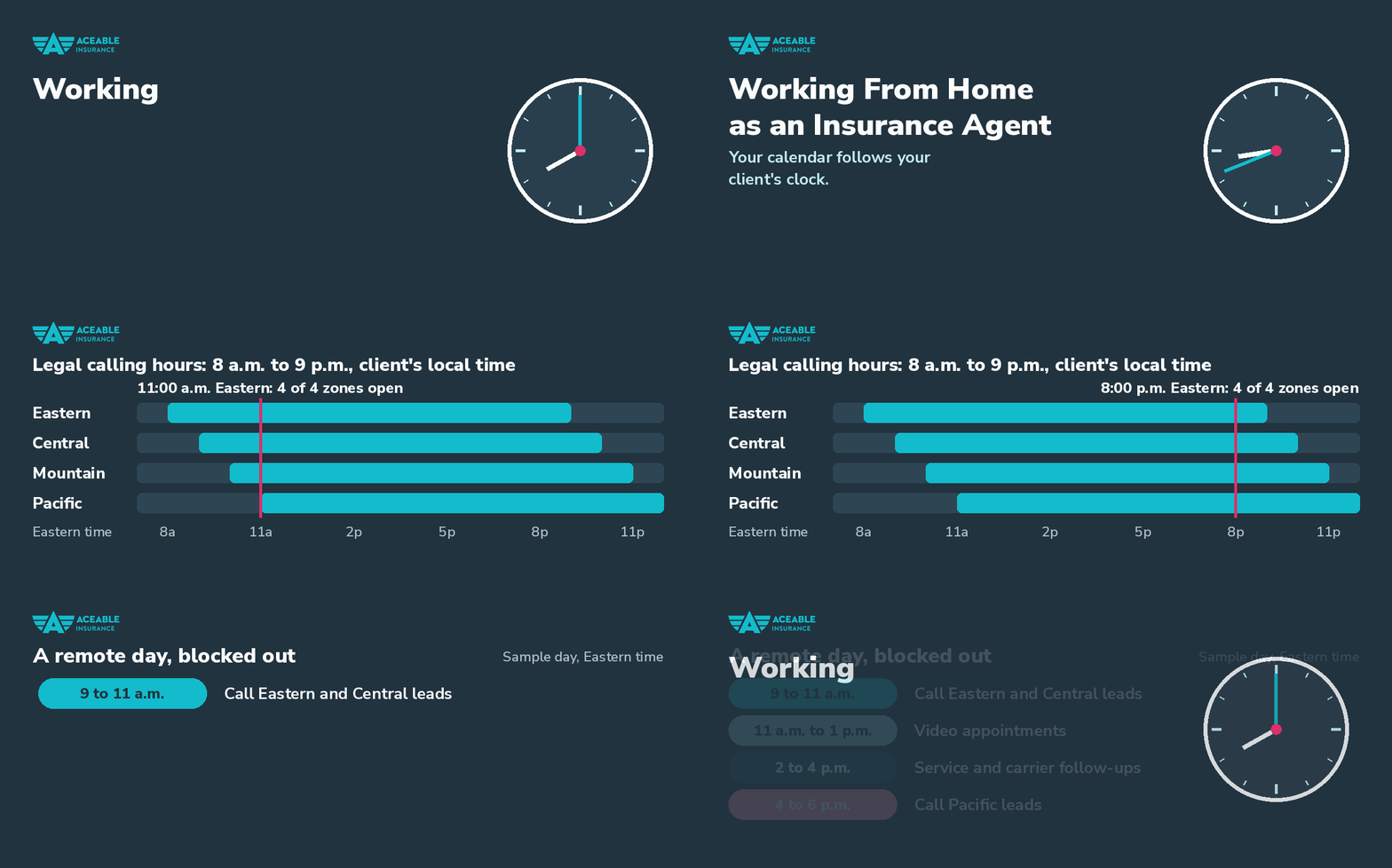
Here is a sample day for an agent on Eastern time who holds licenses in several states. Your hours will flex, but the blocks hold steady:
- 8:00 a.m.: Pipeline review. Flag every policy renewing in the next 30 days.
- 9:00 to 11:00 a.m.: First calling block for Eastern and Central leads.
- 11:00 a.m. to 1:00 p.m.: Video appointments with screen-shared quotes and e-signatures.
- 1:00 to 2:00 p.m.: Lunch, away from the desk.
- 2:00 to 4:00 p.m.: Service work: policy changes, claims help, and carrier follow-ups.
- 4:00 to 6:00 p.m.: Second calling block, which reaches Pacific leads in their early afternoon.
- Two evenings a week: Appointments for clients who work days.
Want to compare this with a traditional schedule? Here is an office-based dayPre License What A Day In The Life Of An Insurance Agent Looks Like Resources for contrast.
Why your calendar should follow your clients' clocks
Federal telemarketing rulesTitle 47 Chapter I Subchapter B Part 64 Subpart L Section 64.1200 Current bar telephone solicitations before 8 a.m. or after 9 p.m. in the called person's local time. An Eastern agent dialing Pacific leads at 9 a.m. is calling at 6 a.m. their time.
Some states set tighter windows, so check the rules for every state where you prospect. The planner below maps your legal calling hours across time zones.
What does a home office need to stay compliant?
Recording Medicare sales calls
If you market Medicare Advantage or Part D plans, CMS guidanceDocument Agent Broker Marketing Faqs 10 19 2022.pdf Files requires recording your sales and enrollment calls with beneficiaries and keeping those recordings for ten years. Set up a recording tool before your first Medicare call, not after.
Protecting client data on a home network
- Separate devices: Keep client work off the family computer.
- Strong logins: Use unique passwords and multi-factor authentication on every carrier portal.
- Private calls: Take appointments where household members cannot overhear policy details.
- Paper discipline: Shred printed applications and never leave them on shared surfaces.
Keeping license records current
Every state where you hold a license keeps your contact details on file. When you move, update each record promptly, and use NIPR servicesNipr.com to handle multiple states at once.
Choose a State and Course
Stay updated with industry news, learn about life as an insurance agent, and get exclusive offers on our course!
How do remote agents sell in more than one state?
- Keep your resident license active. Your home-state resident license is the foundation for everything else.
- Apply for nonresident licenses. Each state sets its own rules. Texas, for example, requires an active license in good standing in your home state and accepts nonresident applications through NIPR or Sircon.
- Get appointed in each state. Carriers must appoint you where you sell their products.
- Track every renewal date separately. Each license renews on its own schedule with its own requirements.
- Map calling hours before you dial. Use the planner below for each time zone you serve.
If a multi-state remote practice is your goal, weigh the life and health license, since those products are often sold by phone and video.
What can slow down a remote insurance career?
- Isolation from mentors. Schedule regular calls with an experienced agent, especially in year one.
- No reliable lead source. Know exactly where your conversations come from before you leave a salaried role.
- A weak setup. Unstable internet or a poor headset costs you appointments.
- Licenses that lag your marketing. You cannot sell in a state until the nonresident license and appointment are active.
- Calling at the wrong local time. Time zone mistakes are both a compliance risk and a quick way to lose a lead.
Remote insurance work: what people ask
Can a brand-new agent work from home?
Yes, though many new agents learn faster with some hands-on mentoring early. Remote teams that provide training and leads are the easiest place to start from home.
Do you need a separate license for every state?
Yes. You hold one resident license in your home state and a nonresident license in each additional state where you sell.
What equipment does a remote insurance agent need?
A reliable computer, stable internet, a quality headset, and a call-recording tool if you sell Medicare plans. A separate work device keeps client data safer.
Do remote Medicare agents have to record calls?
Yes. CMS requires agents marketing Medicare Advantage and Part D plans to record sales and enrollment calls with beneficiaries and keep those recordings for ten years.
Is a commission-only remote insurance job legitimate?
It can be. Commission-only pay is common among independent agents, but read the fine print on required lead purchases, fees, and who owns your renewals before you sign.
How does Aceable Insurance fit a work-from-home career?
If you plan to work from home, it makes sense to learn from home too. Aceable Insurance builds state-approved pre-licensing and continuing education around a mobile-first app, so the same phone you take client calls on can carry your coursework.
Compare online courses, pick up the agent habits that keep remote work productive, then start your course.
that fit their remote work lifestyle. Our online continuing education platform allows you to maintain your professional development on your schedule, from your home office.
Your dog approves this career move.
Work-from-home life starts with state-approved pre-licensing.