
How Do New Insurance Agents Actually Get Trained?
Get Licensed Before Day One
Aceable Insurance pre-licensing is state-approved and mobile-first, so you can finish around the job you have now. Pick your state and your line of authority.
Quick Answer
- The old model was sink or swim. A desk, a phone list, a commission-only contract, and very little else. It produced a small number of strong agents and a large number of people who left within a year.
- The industry is replacing it out of necessity. A retirement wave is pulling experience out faster than it comes in, and agencies that lose a new hire lose the entire cost of recruiting and onboarding them. Structured onboarding, assigned mentors, and staged production goals are becoming standard.
- Insurance sales is now a registered apprenticeship occupation. The U.S. Department of Labor recognizes it, with a framework of paid on-the-job learning plus classroom instruction, and pre-licensing education counts toward the instruction hours.The old model was sink or swim. A desk, a phone list, a commission-only contract, and very little else. It produced a small number of strong agents and a large number of people who left within a year.
- The industry is replacing it out of necessity. A retirement wave is pulling experience out faster than it comes in, and agencies that lose a new hire lose the entire cost of recruiting and onboarding them. Structured onboarding, assigned mentors, and staged production goals are becoming standard.
- Insurance sales is now a registered apprenticeship occupation. The U.S. Department of Labor recognizes it, with a framework of paid on-the-job learning plus classroom instruction, and pre-licensing education counts toward the instruction hours.
Insurance has always trained its new people on the job. What is changing is how much structure sits around that job. The industry is losing decades of expertise to retirement, replacing it with candidates who have no family history in insurance, and discovering that the training approach that worked when agents came up through a family agency does not work when they come from retail, healthcare, or the military. This is what good training looks like now, and how to tell whether the agency recruiting you actually has it.
Why is the insurance industry rethinking how it trains new agents?
Two pressures are pushing in the same direction.
The experience is walking out the door. The insurance workforce skews older than the national average, and a large share of it is at or near retirement age. When a thirty-year producer retires, the client relationships and the judgment leave together. That knowledge only transfers if somebody deliberately moves it, which means mentorship stopped being a nice-to-have and became a continuity plan.
The replacement math is unforgiving. The U.S. Bureau of Labor StatisticsSales Insurance Sales Agents.htm Ooh projects tens of thousands of openings for insurance sales agents every year over the coming decade, and most of them come from replacing people who retire or move to another occupation. An agency that recruits a new agent, licenses them, and loses them in month eight has paid for all of the cost and captured none of the return.
Put those together and training stops being an expense line. It becomes the thing that determines whether the agency still exists in ten years.
What did the old training model actually look like?
It is worth naming, because parts of it still exist and you should recognize them in an interview.
- Licensing was the whole onboarding. Pass the state exam, get appointed, and start. The assumption was that the exam prepared you for the job. It prepares you for the exam.
- Your natural market was the plan. Write policies for family and friends, then cold call once that list runs out. When the list ran out, most people ran out with it.
- Mentorship was informal, if it happened. The veteran across the room helped when they had time, and they usually did not, because they were protecting their own book.
- Product training came from carriers, not the agency. Useful, but organized around one carrier's products rather than around how to serve a client.
This model was not cruel so much as inherited. It worked in an era when new agents arrived already knowing the business. It fails badly with career changers, which is now most of the pipeline. If you are coming in from another field, our guide to starting from scratchPre License How To Become An Insurance Agent With No Experience Resources covers what to expect.
What does a strong new-agent training program include?
Programs vary widely, but the good ones share the same components. Use this as your checklist.
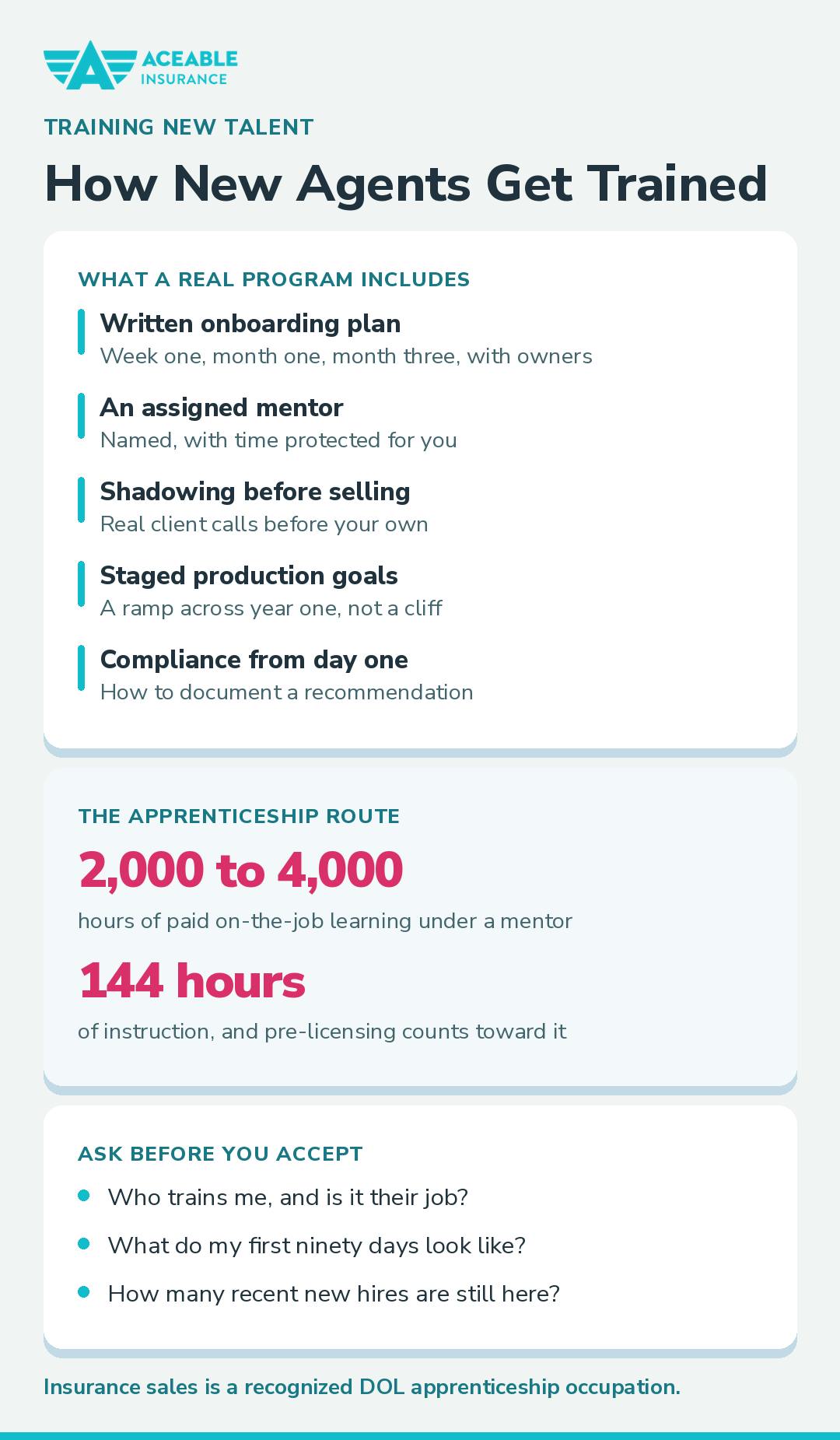
- A written onboarding plan with a timeline. Not a folder of carrier PDFs. An actual sequence covering what you learn in week one, month one, and month three, with someone accountable for each piece.
- An assigned mentor, not an available one. A named producer whose responsibility includes your development, ideally with time protected for it. Ask who your mentor would be and how often you would meet.
- Shadowing before selling. Sitting in on real client conversations, quote reviews, and claims calls before you run your own. You cannot learn what a good discovery conversation sounds like from a script.
- Product and coverage training organized around clients. Not carrier by carrier, but situation by situation. What a small business owner actually needs, what a young family actually needs, and where the standard policy leaves a gap.
- Staged production expectations. Realistic targets that ramp over the first year rather than a full quota in month two. This is the single clearest signal that an agency has thought about retention.
- Compliance and documentation from day one. How to record a recommendation, what to keep in the file, and where the errors and omissions exposure lives. Learning this late is how good agents get into trouble.
- A path past the first year. Which additional lines of authority the agency supports, whether it funds designations, and what the next role looks like.
Notice how much of this is about structure rather than content. The information has always been available. What new agents lack is a sequence and someone to ask.
How do registered apprenticeships fit into insurance training?
This is the development most people entering the field have never heard of. Insurance sales agent is a recognized apprenticeship occupation with the U.S. Department of Labor, listed under standard occupational code 41-3021 in the apprenticeship occupation finderApprenticeship Occupations.
A registered apprenticeship combines paid work with formal instruction. The published framework for insurance sales suggests roughly 2,000 to 4,000 hours of on-the-job learning under a mentor, alongside a recommended minimum of 144 hours of related technical instruction. State pre-licensing education counts toward that instruction requirement, with the balance covering sales practice, client management, proposals, and service skills.
Three things make this worth knowing:
- You earn while you learn. Apprenticeships are paid positions with progressive wage increases, which addresses the biggest practical barrier to entering a commission-driven field.
- Mentorship is built into the structure, not left to goodwill. A registered program has to specify who trains you and on what.
- You finish with a portable credential. A nationally recognized certificate of completion that travels with you if you change employers.
Programs are still limited in number and concentrated with larger carriers and some agency networks, so this is not yet a common entry route. It is worth asking about, and it tells you which employers have invested seriously in training.
Choose a State and Course
What Year One Actually Pays
Before you evaluate a training program, know what the ramp looks like financially. Our salary guide covers first-year ranges, commission structures, and how earnings build by year three.
What should you ask about training before accepting an offer?
Most candidates ask about commission split and nothing about development, then discover the answer in month four. Ask these instead:
- Who trains me, and is it part of their job description? If training is something a producer does between appointments, it will not happen consistently.
- What does my first ninety days look like, in writing? A specific answer means a program exists. A vague one means you are the program.
- How many new agents did you bring on in the last two years, and how many are still here? The most revealing question you can ask, and the one most likely to change the tone of the conversation.
- What are my production expectations by month three, six, and twelve? You want a ramp, not a cliff.
- Do you support additional licenses or designations? An agency investing in your second line of authority is planning to keep you.
- What leads do I get, and where do they come from? "Your network" is an acceptable answer only if it comes with training on how to build one.
Asking these does not make you difficult. It makes you the candidate who has thought about the job, and any agency worth joining will read it that way. The skills agents need include this kind of directness, so you may as well demonstrate it early.
Where does licensing fit in the training path?
Licensing is the first step of training, not a separate hurdle before it. You cannot shadow a client meeting, discuss a plan, or write a policy without a license, which is why every serious program either requires you to be licensed before day one or licenses you during your first weeks.
The format has become far more flexible. Fully online, self-paced pre-licensing courses are accepted in most states, and several states have reduced or removed their required hours entirely while keeping the state exam. That flexibility matters most for career changers studying around an existing job. It also shifts responsibility onto you: where hours are not mandated, the quality of your preparation is the only thing standing between you and a retake.
Choosing the right line of authority at this stage shapes everything after it. Our comparison of P&C and L&H licenses walks through which doors each one opens.
What can you train on your own before day one?
Not everything requires an employer. Four things you can build before you start:
- Product fluency past the exam. Know the difference between term and permanent life, what a business owners policy bundles, and why an umbrella exists. Our overview of insurance career paths maps products to the roles that sell them.
- The client conversation. Practice explaining a deductible, a coverage limit, and an exclusion in plain language to somebody outside the industry. If they get it, you are ready.
- A first outreach plan. Who you would call in week one and what you would say. Walking in with this makes you unusual.
- Basic tool literacy. Agency management systems, quoting platforms, and CRM tools. Nobody expects mastery, but comfort with software shortens your ramp.
Agents who arrive prepared tend to become the ones other people ask for advice within a couple of years. Our roundup of habits worth building covers what that looks like in practice.
Frequently asked questions
Do insurance agencies train you if you have no experience?
Many do, and the strongest programs are specifically designed for career changers. The quality varies enormously, so ask about the written onboarding plan, who your assigned mentor would be, and how many recent new hires are still with the agency.
How long does it take to train a new insurance agent?
Structured programs generally run three to twelve months before an agent is expected to produce independently. The Department of Labor apprenticeship framework for insurance sales suggests 2,000 to 4,000 hours of on-the-job learning, which is roughly one to two years of full-time work.
Is insurance sales a registered apprenticeship occupation?
Yes. Insurance sales agent is listed as a recognized apprenticeship occupation with the U.S. Department of Labor under occupational code 41-3021. Programs combine paid on-the-job learning with related technical instruction, and pre-licensing education counts toward the instruction hours.
Do you need a license before an agency will train you?
Usually yes, at least for anything client-facing. Some employers hire unlicensed candidates and support them through licensing during onboarding, but you cannot discuss products or write business until the license is issued.
Come in already trained on step one
Every training program in the industry starts at the same place: a license. Aceable Insurance pre-licensing is state-approved and built mobile-first, so you can complete it around the job you have now and walk into your first day ready to shadow instead of ready to study. Pick your state, pick your line, and take the part of the process you fully control.
Start where every insurance career starts.
Explore Aceable Insurance pre-licensing courses.