
What Nobody Tells You About Passing the Illinois Insurance Exam

Skip the Retake Fee and Pass the Illinois Exam the First Time
Every Pearson VUE retake means another fee, another trip, and another week of delay. See how Aceable Insurance students prep for exactly what shows up on test day.
Quick Answer:
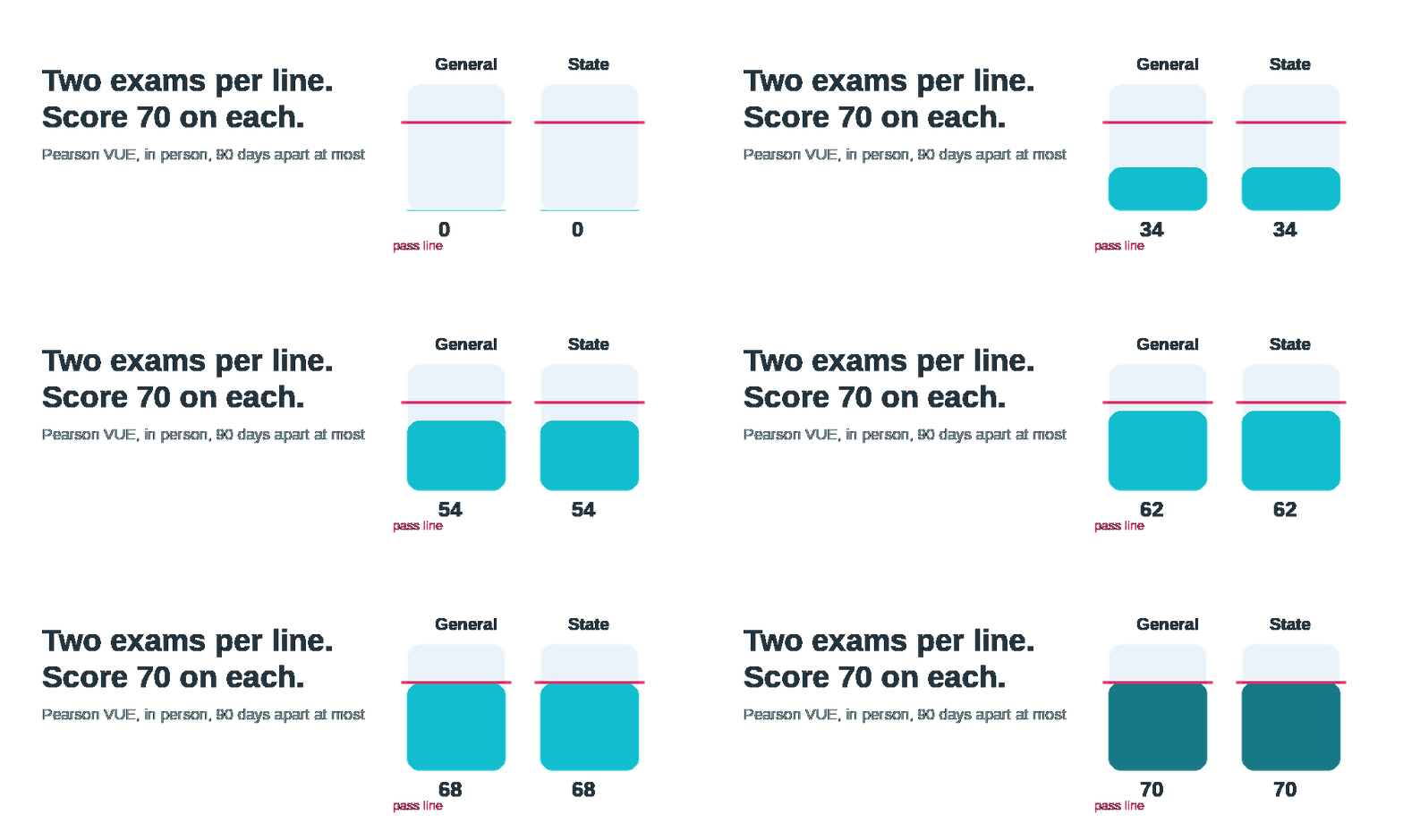
- Illinois gives you two exams per line, a General exam and a State exam, both taken in person at a Pearson VUE test center, and you need a scaled score of 70 on each.
- You must complete 20 hours of pre-licensing per line, including 7.5 live hours, before you can sit, and you must pass both exams for a line within 90 days of each other.
- After your last pass, wait five days, then apply through NIPR to the Illinois Department of Insurance.
The Illinois insurance exam is administered by Pearson VUE on behalf of the Illinois Department of Insurance, the state authority that licenses producers. What surprises most candidates is the structure: Illinois does not give one exam per line. It gives two, a General knowledge exam and a State law exam, and you must pass both within 90 days of each other. A life and health candidate sits four exams in total. We have helped Illinois candidates through every version of this, and the ones who pass on the first try treat it as four short exams to prepare for separately, not one big one.
What is on the Illinois insurance exam?
Each line of authority has its own General exam and its own State exam. The General exam covers insurance concepts and products for that line; the State exam covers Illinois statutes, regulations, and the Department of Insurance's rules on licensing, conduct, and consumer protection.
Life
The General exam covers policy types, riders, underwriting, premiums and proceeds, annuities, retirement plans, and tax treatment. The State exam covers Illinois producer licensing law, replacement rules, and policy provisions the state requires.
Accident and health
The General exam covers individual and group health, disability income, medical expense coverage, long-term care, Medicare and Medicaid basics, and health policy provisions. The State exam covers Illinois-specific mandated benefits, marketing rules, and the state's licensing statutes.
Property and casualty
These are separate lines in Illinois, each with its own General and State exam. Property covers dwelling, homeowners, commercial property, inland marine, and flood; casualty covers auto, general liability, workers' compensation, umbrella, and professional liability. Both State exams cover Illinois producer law plus the state's rules for that line. Deciding which lines to test on comes before any of this, and our guide to Illinois license typesPre License Types Insurance Producer Can Sell Illinois Resources maps each line to the work it allows.
What is the Illinois passing score and question format?
You need a scaled score of 70 on each exam. The exams are multiple choice, timed, and scored immediately, so you leave the test center knowing whether you passed. The exact question counts and time limits are published in the Pearson VUE Illinois candidate handbook and updated periodically, so check the current handbook before your test date.
What "scaled score" means
A scaled score of 70 is not the same as answering 70 percent of questions correctly. Pearson VUE converts your raw score to a scale that adjusts for the difficulty of the question set you received. Each exam also includes a handful of unscored pretest questions that do not count toward your result, so do not panic over a question that seems to come from nowhere.
How long are the exams?
General exams run roughly an hour and a half; State exams run under an hour. Most candidates schedule the General and State exams for one line back to back on the same day.
What pre-licensing hours does Illinois require before you sit?
Illinois requires 20 hours of approved pre-licensing education for each line of authority, and 7.5 of those hours must be completed in a classroom or live webinar with verified attendance. The remaining 12.5 hours can be self-study. The one exception is the motor vehicle limited line, which requires 12.5 hours with 5 live.
- Life: 20 hours, 7.5 live
- Accident and health: 20 hours, 7.5 live
- Property: 20 hours, 7.5 live
- Casualty: 20 hours, 7.5 live
- Personal lines: 20 hours, 7.5 live
What does the course end with?
A certification exam from your provider. Pass it and you receive a certificate of completion for that line, which you must present at the Pearson VUE test center. The certificate is valid for one year from the course completion date. Miss that window without passing the state exams and you retake the full course. Our step-by-step guide to licensing in IllinoisPre License How To Get Your Insurance License In Illinois Resources covers the course requirements in detail.
Choose a State and Course
Illinois Producer Pay by Line
Pick the line to test with income data- not guesswork- with our FREE salary guide.
How do you book your Illinois exam?
- Finish your 20-hour course and download your certificate of completion.
- Create an account with Pearson VUE and select Illinois insurance.
- Register for the General exam and the State exam for your line. Each requires its own registration, and you can schedule them for the same day.
- Pay the exam fee at booking. Fees are per exam and are not refunded for no-shows or failures.
- Choose an in-person test center. Illinois does not currently offer remote proctoring for producer exams, so plan for travel.
- Bring two forms of ID and your certificate. The primary ID must be government-issued with a photo and signature. Arrive 30 minutes early.
Test dates fill fastest in the last two weeks of each month. If you have a start date with an employer, book both exams the day you finish the course.
What happens if you do not pass?
You can register again with Pearson VUE and retest. There is no cap on attempts, but every sitting costs a new exam fee, and there is a timing trap: if you passed one of the two exams for a line, you must pass the other within 90 days of that first pass or the first result expires and you take both again.
How to prepare for a retake
- Read the score report. Pearson VUE gives you a breakdown by content area. Study only the weak sections.
- Retest within two to three weeks. Long enough to fix the gaps, short enough that the material stays fresh and the 90-day clock does not run out.
- Take the State exam seriously. Candidates who fail in Illinois most often fail the State law exam, because the course time goes to products and the Illinois statutes get skimmed.
Failing one exam does not affect your certificate of completion, which stays valid for the full year.
After you pass, how do you apply for your Illinois license?
- Wait five days after your final exam pass. Illinois requires the wait so Pearson VUE can transmit your results to the Department of Insurance.
- Apply through the National Insurance Producer Registry. Submit a resident individual license application for Illinois listing every line you passed. Instructions are on the Illinois Department of Insurance producer page.
- Answer the background questions completely. Illinois does not fingerprint producer applicants; it relies on your disclosures, and nondisclosure is what gets applications denied.
- Pay the state license fee and NIPR's transaction fee. One application covers every line you passed.
- Print your license once the Department approves it, usually within a few business days, and get appointed by your carrier.
Your exam passes are valid for one year, so there is no rush beyond the five-day wait, but there is also no reason to sit on a passed exam while an employer waits. Once licensed, our guide to Illinois career launch covers appointments and the first ninety days.
How does Illinois compare to other states?
Illinois is one of a minority of states that splits each line into two exams and requires live instruction hours inside pre-licensing. Ohio uses one exam per line through PSI and requires fingerprinting; Tennessee uses Pearson VUE like Illinois but requires no pre-licensing at all. Illinois's five-day post-exam wait and 90-day pairing rule are unique enough that candidates who studied out-of-state guides get caught by them. Illinois also has one of the largest insurance job markets in the country, which is why the extra structure is worth it; our breakdown of Illinois agent income shows the upside.
What can slow down the licensing process in Illinois?
- Scheduling the 7.5 live hours around a full-time job, which delays the certificate
- Passing one exam and letting 90 days lapse before passing the other
- Limited Pearson VUE seats near you at the end of the month
- Applying before the five-day wait ends, which stalls the application
- Name mismatches between your ID, Pearson VUE profile, and NIPR application
Illinois insurance exam: frequently asked questions
Who administers the Illinois insurance exam?
Pearson VUE, on behalf of the Illinois Department of Insurance. Exams are taken in person at a test center.
What score do I need to pass in Illinois?
A scaled score of 70 on each exam. Every line has a General exam and a State exam, and you must pass both within 90 days of each other.
How many times can I take the Illinois insurance exam?
There is no attempt limit, but each sitting requires a new registration and fee, and the 90-day pairing rule still applies.
Do I need pre-licensing before the Illinois exam?
Yes. Twenty hours per line, including 7.5 hours of live classroom or webinar instruction, with a certificate valid for one year.
How soon can I apply after passing?
Five days after your final pass, through NIPR. Approval typically follows within a few business days.
Walk into Pearson VUE already knowing what is on the screen
Four short exams, two per line, each built from a published outline. That is a solvable problem when your course is organized around the actual exam rather than a textbook. Aceable Insurance's Illinois pre-licensing courses include the required 7.5 live hours, mirror the Pearson VUE content outlines, and drill you on the Illinois State law exam that trips up most first-timers. Still deciding on a line? Our guide to first license choice can settle it in five minutes. Then choose your Illinois course and book your test date with confidence.
Last reviewed by the Aceable Insurance compliance content team against Illinois Department of Insurance producer licensing requirements and the Pearson VUE Illinois insurance candidate handbook.
Take the first step toward getting licensed.
Access expert-backed resources designed to guide you through the Illinois insurance exam with confidence.