
Insurance Agent vs. Broker vs. Producer: What's the Difference?

Title Decided? License First
Agent, broker, and producer all start with the same exam, and our course gets you ready for it.
Quick Answer:
- Producer is the license. In most states, there is one credential: a producer license. An agent and a broker describe how you work, not separate licenses.
- Who you represent is the real difference. An agent represents the insurance company. A broker represents the client and shops multiple carriers.
- A few states still split them. California and a handful of others treat brokers as a distinct, separately bonded role.
The short version: in most states there is only one license, and it is a producer license. Agent and broker are usually not separate licenses. They describe whose interests you represent and how you sell.
The words get blurred in everyday conversation, and a few states still draw a hard legal line. That is where the confusion starts. Here is what each one means and when the difference actually matters.
What Does "Insurance Producer" Mean?
A producer is anyone a state has licensed to sell, solicit, or negotiate insurance. The term comes from the NAIC Producer Licensing Model ActInsurance Topics Producer Licensing Content.naic.org, model legislation that nearly every state adopted to standardize licensing.
Before it, states issued separate agent and broker licenses with different rules.
Today, when you pass your state exam and get your licensePre License How To Get An Insurance License Resources, the credential you receive is a producer license, whether your business card says agent or broker. On your official record and in national databases, you are a producer.
What Is an Insurance Agent?
An agent represents the insurance company. Agents are appointed by one or more carriers, and that appointment is what formally authorizes them to sell those carriers' products.
If you want a fuller picture of the day to day, see what agents doPre License What Does Insurance Agent Do Resources.
Captive vs. independent agents
- Captive agents. Represent a single company. You typically get brand recognition, structured training, and leads, in exchange for less flexibility in the products you can offer.
- Independent agents. Represent several carriers and shop among them for each client. More product choice and autonomy, and more responsibility for generating your own business. This is usually where the word broker enters the conversation.
What Is an Insurance Broker?
A broker represents the client, not the carrier. Instead of being appointed to sell one company's products, a broker shops the market on the buyer's behalf and is generally not tied to a single insurer.
In states that fold everything into one producer license, broker mostly describes this client-first, multi-carrier approach rather than a separate credential.
Is There Really a Difference Between an Agent and a Broker?
For most producers in most states, the difference is about positioning and duty, not paperwork. When a producer calls themselves a broker, what they usually mean is that they are independent and will shop multiple carriers for you.
The duty can differ in practice. An agent generally owes primary loyalty to the insurer that appointed them, while a broker is working for the buyer.
Being clear with clients about which one you are is more than a technicality. It sets expectations and builds trust, which is a big part of building a lasting insurance careerPre License Is Insurance A Good Career Resources.
Choose a State and Course
Put a Number on the Title
Find out what your producer license can be worth across different roles.
Which States Treat Brokers Differently?
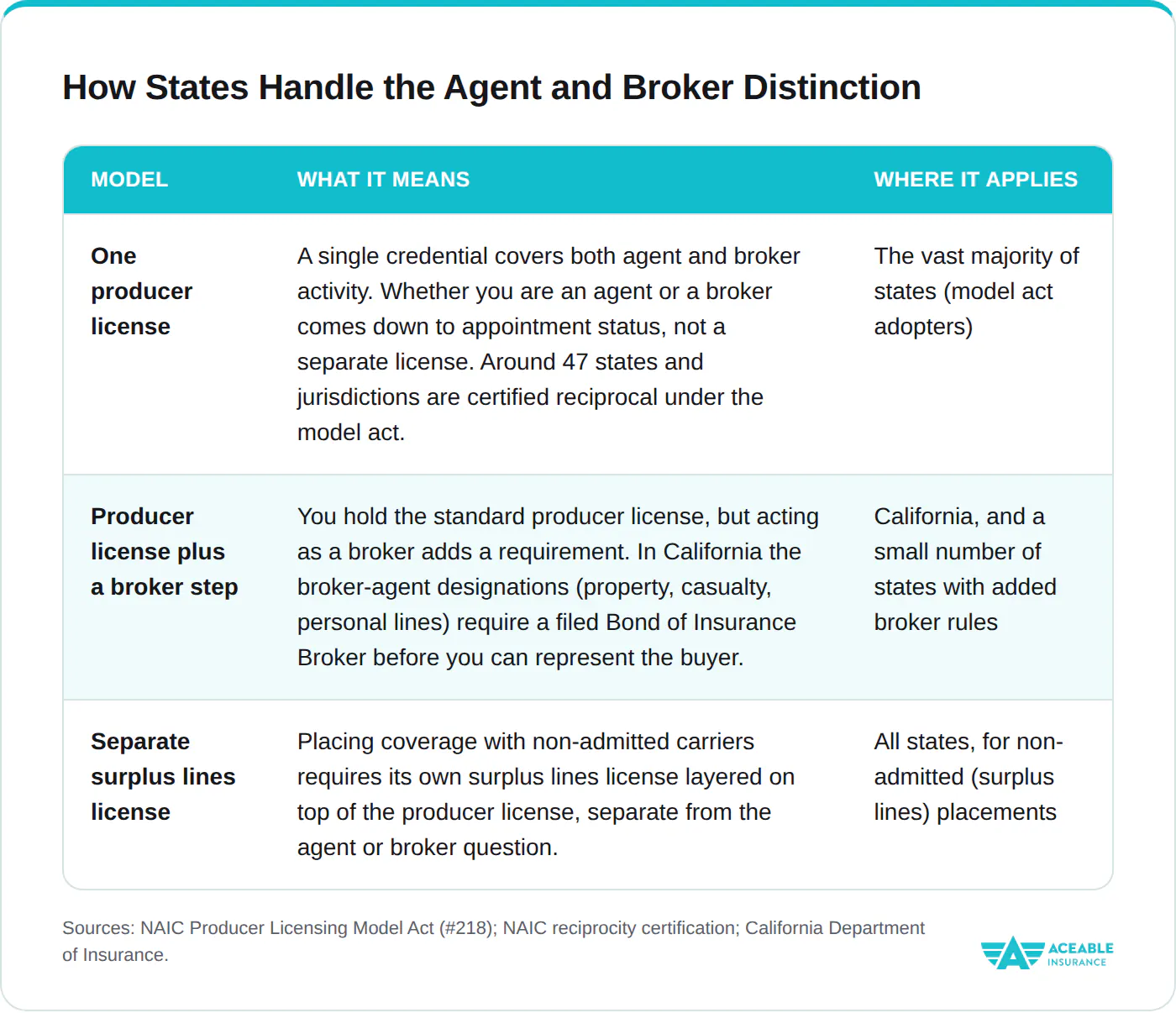
A few states still draw a real legal line, and California is the clearest example. California issues broker-agent licenses: property broker-agent, casualty broker-agent, and personal lines broker-agent.
Whether you can act as a broker there depends on filing a Bond of Insurance Broker with the California Department of Insurance. Post the bond and you are authorized to act as a broker, representing the client rather than the insurer.
What this means across state lines
Because your underlying credential is a producer license, you generally carry it into other states through reciprocity.
Local rules can still apply on top, like California's broker bond. Always confirm the specifics with the state insurance department before you market yourself a certain way there.
Do You Need a Different License to Become a Broker?
In most states, no. You earn one producer license and then choose how you work.
In states like California, acting as a broker adds a step, the bond, but you are not starting over with a different license.
If you are weighing which path fits you, the bigger decision is usually your license types and whether you want to go captive or independent.
How Do You Become a Licensed Insurance Producer?
The path is the same whether you plan to work as an agent or a broker:
- Meet your state's pre-licensing education requirement, if it has one.
- Pass the state licensing exam for your line of authority.
- Complete any background check or fingerprinting your state requires.
- Apply for your producer license through your state or the National Insurance Producer Registry.
- Get appointed by a carrier if you plan to work as an agent, or set up your brokerage relationships.
What if you want to work as a broker?
You follow the same five steps. In most states nothing changes.
In states with a separate broker track, like California, you add the bond and any extra filing the state requires. For a state-by-state walk through, start with our rundown of common licensing questions.
Which Title Should You Use With Clients?
Use the one that is accurate. If you represent a single carrier, you are an agent. If you shop multiple carriers for the client, broker or independent agent signals that clearly.
What matters more than the label is being honest about whose interests you represent. That clarity is what earns referrals and repeat business.
Whatever you call yourself, it all starts with one credential: a state producer license. Aceable Insurance builds state-approved, mobile-friendly pre-licensing course options so you can pass the exam and start working as the kind of producer you want to be.
Your Path Starts With One Exam
Study on your phone, on your schedule, and walk into the exam ready.