
How Do Florida Insurance Agents Help Clients Get Ready for Hurricane Season?

Storm season is coming. Your future clients want a guide.
Florida P&C agents who know the deductible structure, mitigation credits, and Citizens rules cold win the hard conversations. Aceable's Florida pre-licensing gets you there.
Quick Answer
- Start the conversation in April. Atlantic hurricane season runs June 1 through November 30, with the most active stretch from August through October. Clients who understand their coverage before a storm has a name make calmer decisions and recover faster.
- Three conversations matter most: what the hurricane deductible means in real dollars for that household, why flood is a separate policy, and how wind mitigation features can lower the windstorm premium.
- The agent's job is to be the calm, prepared voice before, during, and after a storm. Clients remember who called to ask if they were safe. Retention follows from that, not the other way around.
When a hurricane hits Florida, the difference between a family that recovers in months and one that struggles for years often comes down to conversations that happened in the spring. Florida property and casualty agents are in a unique position to have those conversations, and it is a big part of why a P&C licensePre License Is Becoming A Licensed Property And Casualty Insurance Agent Worth It Resources carries so much weight in this state. This guide covers what to say, when to say it, and how to stay present for clients through the whole season, from the first pre-season review to the follow-up call months after landfall.
When does Florida hurricane season start, and when should agents start preparing?
The National Hurricane Center defines the Atlantic hurricane season as June 1 through November 30 each year, with peak activity typically from August through October. Florida has more hurricane landfalls than any other state, and its exposure runs the full length of both coasts. Inland counties regularly see hurricane-force winds well after a storm crosses the shoreline.
For agents, the working season begins in April. By late May, clients are already watching forecasts and receiving carrier emails, and a policy review competes with anxiety for their attention. In April, the same review lands as a service.
What does a pre-season outreach calendar look like for Florida agents?
A written cadence is what separates agents who intend to reach out from agents who do. Here is one that works:
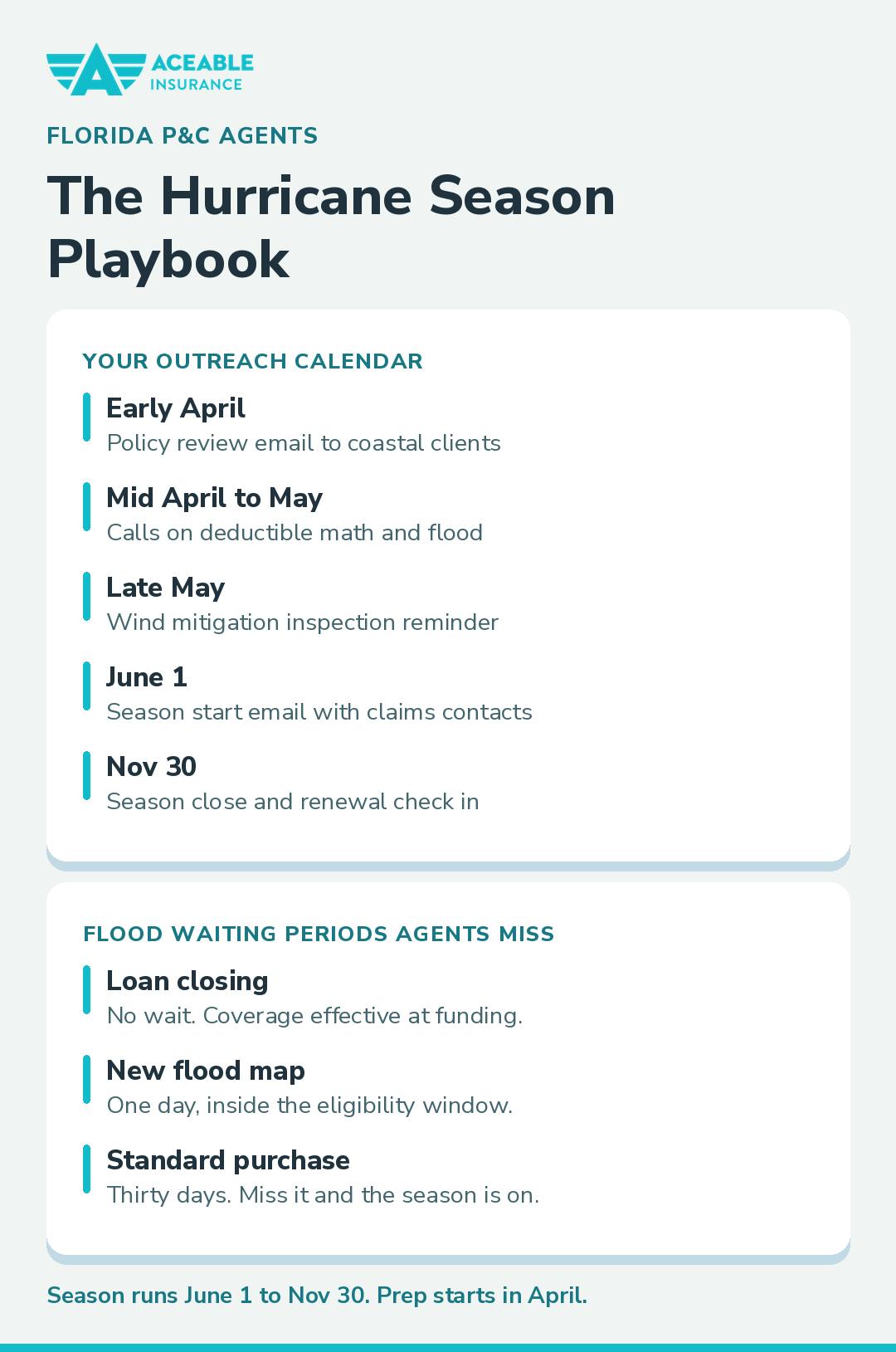
- Early April: Annual policy review email to every coastal and high-exposure client. Goal: confirm replacement cost is current and surface any coverage gaps.
- Mid-April to early May: Personal calls or video calls with your highest-exposure households. Goal: walk through the deductible in actual dollars for their home.
- Mid-May: Pre-season checklist email with a documentation guide. Goal: help clients gather records and contact information before they need them.
- Late May: Wind mitigation inspection reminder for clients who have never had one. Goal: capture available discounts before the season starts.
- June 1: Season-start email with a claims contact reference card. Goal: make sure you are the first call when a storm approaches.
- Storm by storm: Pre-storm, during-storm, and post-storm communication (detailed below).
- November 30: Season-end check-in and renewal preview. Goal: close the season the way you opened it, with a personal touch.
The value is in the consistency. No single email matters as much as the fact that your clients hear from you every step of the way.
What should agents review with Florida clients before hurricane season?
Six topics deserve dedicated attention with every coastal client each spring. Work through them in order and document each conversation.
- Confirm replacement cost is current. Construction costs shift, and a dwelling limit set several years ago may no longer rebuild the home. Run the carrier's replacement cost estimator and note the result in the file.
- Translate the hurricane deductible into dollars. Pull the declarations page. Florida hurricane deductibles are typically a percentage of the dwelling limit, and under Section 627.701, Florida StatutesStatutes 2021 627.701 Laws, insurers must offer specific percentage options and disclose the deductible clearly. Do the multiplication with the client so the number is real before a storm makes it real.
- Address flood coverage explicitly. Homeowners policies do not cover flood, and storm surge is flood. Point clients to the National Flood Insurance Program (NFIP) or an eligible private flood carrier well before June. Knowing how P&C linesPre License Property And Casualty Vs Life And Health Vs All Lines Resources interact with adjacent products is one of the most valuable habits a Florida agent can build.
- Review additional living expense (ALE) limits. If a home is uninhabitable for months, ALE is what keeps the family housed and the kids in their school. Make sure the limit matches the client's real situation.
- Encourage a home inventory now. A room-by-room video on a phone, backed up to the cloud, moves a claim faster than any other single piece of documentation.
- Verify contact information. Cell numbers, email, and an out-of-state emergency contact. Post-storm outreach fails if the file is stale.
Documenting these reviews protects your client and protects you. The most effective agentsPre License Tips Becoming A Successful Insurance Agent Resources treat the notes as part of the service, not paperwork after it.
Choose a State and Course
Coastal exposure. Coastal earnings.
Free FL salary guide. What hurricane-market agents actually take home.
What are the flood insurance waiting period exceptions agents miss?
Most agents know the NFIP has a 30-day waiting period. Fewer know the exceptions, and defaulting to 30 days when an exception applies can cost a client coverage they were entitled to have immediately. According to FEMA, the standard wait does not apply in several situations:
- Loan closing. When flood insurance is required in connection with making, increasing, extending, or renewing a loan, coverage is generally effective at closing with no waiting period, provided the application and premium are submitted on or before the closing date.
- New flood map. If a map revision newly places a property in a Special Flood Hazard Area, a one-day waiting period applies when the purchase is made within the eligibility window that follows the map change.
- Post-wildfire flooding. A shortened waiting period can apply when a policy is purchased soon after containment of a wildfire on federal land and the flood damage is attributable to that fire.
Private flood carriers set their own effective dates and often have shorter waits than the NFIP. For a client who calls in late May wanting flood coverage before season, the private market may be the only route to coverage in time. Know which private flood markets you can access before that call comes.
The takeaway for your April outreach: the flood conversation has a hard deadline. A client who waits until a storm is in the forecast has almost certainly missed it.
How do wind mitigation discounts work in Florida?
This is one of the most useful things a Florida agent can teach a client. Under Section 627.0629, Florida Statutes, residential property insurers must offer premium discounts for verified construction features that reduce windstorm losses. The discount applies to the windstorm portion of the premium.
Features that commonly qualify:
- Roof shape. Hip roofs perform better in high winds than gable roofs.
- Roof deck attachment. Stronger nailing patterns earn credit.
- Roof-to-wall connection. Hurricane clips or straps outperform toe-nailed connections.
- Roof covering. Coverings that meet current building code standards.
- Opening protection. Shutters or impact-rated windows and doors are among the largest discount drivers.
- Secondary water resistance. A sealed roof deck that limits water intrusion if the covering fails.
Two details worth knowing that most clients never hear:
- Carriers must publish their mitigation discounts. Section 627.0629 requires residential property insurers to post information describing available hurricane mitigation discounts on their website, reachable from the home page or the primary property insurance page. You can send a client directly to their own carrier's discount page instead of describing it secondhand.
- The inspection form has a shelf life. The Uniform Mitigation Verification Inspection Form, designated OIR-B1-1802, is generally valid for up to five years as long as no material changes are made to the structure and no inaccuracies are found. Florida's Office of Insurance Regulation (OIR) periodically updates the form and reevaluates the qualifying features and credits, so confirm your client's inspector is using the current version. The OIR wind mitigation resources page is the place to verify.
To claim the discounts, the client needs a Uniform Mitigation Verification Inspection form completed by a qualified inspector. Florida's My Safe Florida Home program, run by the Florida Department of Financial Services (DFS), provides free wind mitigation inspections to eligible homeowners and offers matching grants for recommended improvements when funding is available. Eligibility and funding change from cycle to cycle, so send clients to the official program page rather than quoting terms. An agent who points a family to a free state inspection builds a kind of trust no quote can.
What should clients have ready before a storm?
Send a pre-season packet with this list, and suggest clients keep copies in a waterproof container, in cloud storage, and with someone outside the storm zone.
- Homeowners declarations page
- Flood policy, if they have one
- Your contact information and the carrier's claims line
- Room-by-room photo or video inventory
- Receipts or appraisals for high-value items
- Model and serial numbers for major appliances and electronics
- Copies of the mitigation inspection form, if applicable
How should Florida agents communicate during and after a storm?
Set expectations before landfall so nobody is guessing when the power is out. This is where the communication skills that make a good agent matter most. Six touchpoints, in order:
- Pre-storm (roughly 24 to 48 hours before landfall). Email everyone in the projected impact area. Confirm how to reach you, remind them to photograph the home, and share the carrier claims number again.
- During the storm. Stay safe and stay reachable. Clients rarely call mid-storm, but they text.
- 24 to 48 hours after. Reach out to every client in the impact zone. The first question is whether they and their family are safe. Everything else waits.
- Week one. Help clients document damage, get the claim opened, and understand what happens next. You are the guide, not the adjuster.
- Week three. Check on claim progress and surface any adjuster issues early.
- Month two and beyond. Recovery takes longer than people expect. The agents clients remember are the ones who called at month two, month three, and month six.
The Florida DFS consumer guide to hurricane deductibles is a resource you can share directly with clients who want to read the rules for themselves.
What should agents know about Florida hurricane deductible rules at claim time?
Section 627.701 sets rules that come up in almost every hurricane claim conversation:
- Once per calendar year, per insurer. The hurricane deductible applies on an annual basis to all covered hurricane losses in the same calendar year with the same insurer or insurer group. If the full deductible was met in an earlier storm, a later storm that year is subject to the greater of the remaining hurricane deductible or the all-other-perils deductible.
- The trigger window is defined by statute. Under Section 627.4025, a hurricane loss is one that occurs from the time the National Hurricane Center issues a hurricane watch or warning for any part of Florida until 72 hours after the last watch or warning is lifted.
- No stacking. When the hurricane deductible applies, no other deductible under the policy applies to the same loss.
- Switching carriers resets the clock. The annual application only holds with the same insurer or insurer group. A client who changes carriers mid-year faces the new carrier's full hurricane deductible.
When damage occurs near the edge of the trigger window, or when wind and water damage are both present, clean documentation of timing and cause is what keeps a claim moving. Walk clients through that before they need it.
Which parts of Florida carry the highest hurricane exposure?
Carriers rate exposure differently, but these regions consistently sit at the high end:
- Miami-Dade and Broward (the High-Velocity Hurricane Zone). The strictest building code in the state and the highest baseline exposure.
- Monroe County and the Keys. Water on every side and a limited private market.
- Tampa Bay (Hillsborough, Pinellas, Pasco). Significant Gulf surge risk.
- Southwest Florida (Lee, Collier, Charlotte). Recent landfalls have reshaped the market here.
- The Panhandle (Bay, Walton, Okaloosa, Escambia). Regular Gulf-side impacts.
- The Atlantic coast (Brevard, Volusia, St. Johns, Duval). Exposure varies by storm track.
Many clients in these areas are insured through Citizens Property Insurance Corporation, the state-created insurer of last resort, or carry mandatory percentage deductibles. Know which category each client falls into before the season starts. Agents who master this local knowledge are the ones whose license value grows year over year.
What gets in the way of good hurricane preparation?
- Starting in June. By then, clients are anxious and inboxes are full. April conversations land as help.
- Skipping the deductible math. A percentage on a declarations page does not feel real until it is converted to a dollar figure for that specific home.
- Leaving flood out of the conversation. Hurricane outreach without a flood conversation is incomplete.
- Generic mass emails to everyone. Personalized outreach to high-exposure clients is what actually gets read.
- Not documenting the pre-season review. If a gap surfaces at claim time, your notes are how you show the client was informed.
- Treating each season as a one-off. Build the calendar once and run it every year.
Frequently asked questions
When does hurricane season start in Florida?
The Atlantic hurricane season runs June 1 through November 30, with the most active period from August through October. Florida agents typically begin pre-season client outreach in April.
Does a Florida homeowners policy cover storm surge?
No. Storm surge is flood damage, and flood is excluded from standard homeowners policies. Clients need a separate flood policy through the National Flood Insurance Program or a private flood carrier.
How many times can a Florida hurricane deductible apply in one year?
Under Section 627.701, Florida Statutes, the hurricane deductible applies once per calendar year for losses with the same insurer or insurer group. Later hurricane losses in the same year are subject to the greater of the remaining hurricane deductible or the all-other-perils deductible.
What license do you need to sell homeowners insurance in Florida?
Homeowners insurance falls under property and casualty. Florida agents are licensed through the Florida Department of Financial Services, and the state licensing exam is administered by Pearson VUE.
Be the agent Florida families are glad they called
Every hurricane season, Floridians look for someone who can explain their coverage in plain language and stay present when things get hard. That agent has to be licensed first. Aceable Insurance's Florida property and casualty pre-licensing course is approved by the Florida Department of Financial Services, built mobile-first so you can study anywhere, and designed to help you walk into the Pearson VUE exam with confidence. Already licensed? Our Florida CE courses keep you compliant on your own schedule.
Six months of hurricane season. Twelve months of client retention.
Aceable's Florida pre-licensing is mobile-first, exam-prep heavy, and FLDFS-approved. Get licensed in weeks and start serving clients before the next storm name.