
Insurance Readiness Index
Why Test Scores Don't Predict Career Success
Stay updated with industry news, learn about life as an insurance agent, and get exclusive offers on our course!
Quick Takeaways:
- While 90% of insurance professionals felt prepared for licensing exams, 85% had to learn essential job skills independently after starting work
- Traditional education creates a false confidence gap where exam success doesn't translate to career readiness or real-world performance
- Comprehensive preparation addressing practical skills shows 77% better job satisfaction and 84% higher career confidence among insurance professionals
A new survey of 602 licensed insurance professionals across 46 states reveals a pattern in how the industry prepares new talent.
What Licensing Exams Actually Measure
Traditional insurance licensing exams test your ability to recall facts under pressure, not your ability to apply knowledge in real situations. The research shows 47% of professionals felt their courses emphasized memorization over practical application, creating professionals who can pass tests but struggle with actual client interactions.
The Memorization Problem
Insurance exams typically assess:
- Recall of policy definitions and terms
- Regulatory requirement details
- Mathematical calculation accuracy
- Multiple-choice pattern recognition
But what insurance agents actually do requires completely different competencies:
- Explaining complex coverage in simple, accessible terms
- Managing difficult customer situations professionally
- Using industry software and digital tools effectively
- Building long-term client relationships and trust
According to the National Association of Insurance Commissioners, most consumer complaints stem from communication problems rather than policy issues. Yet pre-licensing education focuses almost exclusively on policy knowledge, leaving new professionals unprepared for the human element of insurance work.
The False Confidence Gap
When 90% of professionals feel exam-ready but 85% struggle with basic job functions, it creates what researchers call a "false confidence gap." New professionals enter the workforce believing they're prepared, only to discover within days that they lack essential skills for daily work.
This confidence gap leads to:
- Increased stress and self-doubt in early career stages
- Higher rates of early career burnout
- Talented professionals leaving the industry unnecessarily
- Extended learning curves that delay productivity
The research found that nearly one in three professionals considered giving up on the path to licensure at some point during their preparation. Those newest to the industry, with one year or less of experience, were 68% more likely to report considering quitting.
For professionals wondering how to become an insurance agent with no experience, understanding these industry-wide challenges helps inform better preparation choices from the start.
What Actually Predicts Career Success
The Insurance Readiness Index identifies three critical factors that actually correlate with long-term success in insurance careers, none of which are measured by traditional licensing exams.
Real-World Problem Solving
The research shows 73% of professionals want real-world scenarios integrated into training because they recognize the gap between knowing facts and solving actual problems. Being able to analyze a client's specific situation, recommend appropriate coverage levels, and explain trade-offs in language the client understands represents true professional competence.
This application ability can't be measured by multiple-choice questions, but it directly impacts career success and client satisfaction.
Communication and Relationship Skills
Seventy percent of professionals had to learn client management skills independently, and 55% needed to develop customer conversation abilities on their own. These represent core competencies that exam scores completely ignore.
Critical communication skills include:
- De-escalating frustrated or upset customers
- Explaining complex insurance concepts clearly
- Handling objections and concerns professionally
- Building trust and rapport quickly with diverse clients
- Managing difficult conversations with confidence
The survey found that professionals who develop strong communication skills early report significantly higher job satisfaction and career confidence. Yet most pre-licensing programs provide no structured training in these essential areas.
Technology and Business Skills
Fifty-two percent of surveyed professionals had to learn sales and quoting tools independently, with independent agents 25% more likely to face this challenge. Modern insurance work requires practical technology skills that exam scores can't measure:
Essential technology competencies:
- Navigating quoting system interfaces efficiently
- Using customer relationship management platforms
- Leveraging digital communication tools effectively
- Analyzing data and generating reports
Business development skills:
- Managing the sales process systematically
- Implementing customer acquisition strategies
- Building professional networks and relationships
- Analyzing markets and positioning services
The Independent Agent Challenge
The research reveals that independent agents face significantly higher skill gaps because they lack the support systems of large agencies:
- 20% more likely to need customer conversation training
- 25% more likely to require sales tool instruction
- 20% more likely to need relationship-building guidance
Yet licensing exams treat all career paths identically, providing no indication of these different preparation needs or success requirements. Independent agents must develop comprehensive business skills that employed agents can rely on their agencies to provide, but exam scores give no insight into these capabilities.
What Modern Professionals Want
The research shows overwhelming demand for education that addresses real career preparation needs rather than just exam passage.
Practical Application Focus
Modern learners want:
- Real-world scenarios integrated throughout training (73%)
- Interactive assessments that test application, not memorization (58%)
- Mobile and flexible learning that fits their lives (52%)
This aligns with research from the National Center for Biotechnology Information showing scenario-based learning significantly improves both knowledge retention and practical application skills.
Comprehensive Skill Development
Today's insurance professionals recognize they need more than regulatory knowledge:
- Communication Training: Structured practice in customer conversations, objection handling, and relationship building through role-playing and feedback.
- Technology Integration: Hands-on experience with industry software and digital tools that mirror actual workplace requirements.
- Business Context: Understanding how insurance businesses operate, succeed, and compete in modern markets.
Flexible, Supportive Learning
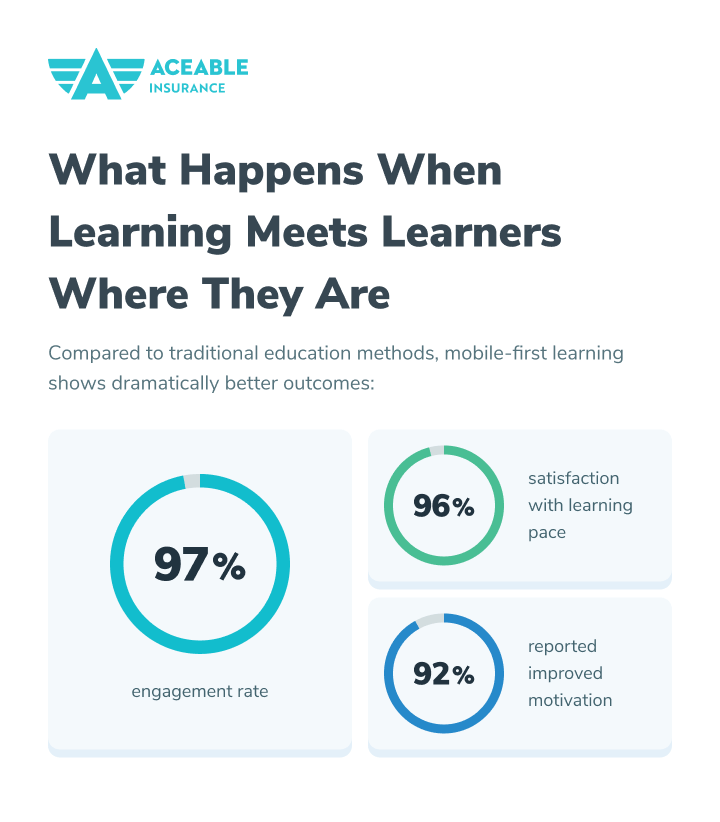
- Mobile-First Preferences: Fifty-two percent want mobile learning that accommodates work and family commitments while maintaining educational quality. The research found that 56% of professionals licensed in the past decade chose mobile-first learning for pre-licensure education.
- Expert Guidance: Access to experienced professionals for questions and career advice throughout the learning process, not just during scheduled class times.
- Peer Community: Opportunities to learn from and network with other students and practicing professionals who understand the challenges of entering the field.
The Cost of Exam-Focused Education
The focus on exam passage over career preparation creates measurable costs across the industry.
For New Professionals
- Extended Learning Curve: New hires spend months figuring out basics that comprehensive education should have covered, rather than contributing value immediately.
- Stress and Anxiety: The gap between exam confidence and job reality creates stress that can derail promising careers before they truly begin.
- Career Uncertainty: Professionals who struggle early often question their career choice and may leave the industry entirely, representing lost talent and wasted training investment.
For Agencies and Employers
- Higher Training Costs: Agencies must provide extensive remedial training for skills that proper pre-licensing education should have developed.
- Delayed Productivity: New hires with substantial skill gaps take significantly longer to become profitable contributors.
- Customer Service Issues: Unprepared professionals create negative customer experiences that damage relationships, reputation, and retention.
- Increased Turnover: Early career struggles result in higher attrition rates and ongoing recruitment needs, leading to constant costs.
For the Industry
- Talent Attraction Problems: Bright candidates may avoid careers where success seems unpredictable and preparation appears inadequate.
- Professional Reputation: Poor early experiences by unprepared agents damage public perception of the entire insurance industry.
- Competitive Disadvantage: Other industries with better preparation programs attract top talent that insurance loses unnecessarily.
What Comprehensive Preparation Looks Like
Quality insurance education integrates practical skills with regulatory knowledge, creating professionals who are truly ready for career success.
Scenario-Based Learning
Instead of memorizing isolated facts, comprehensive programs integrate knowledge through realistic scenarios:
- Client Consultation Simulations: Practice explaining coverage options to different personality types and financial situations with immediate feedback.
- Problem-Resolution Exercises: Work through actual claim disputes, coverage gaps, and customer complaints that mirror real workplace challenges.
- Sales Process Practice: Develop consultative selling skills through structured role-playing that builds confidence and competence.
Skill Integration
Modern programs address the full range of professional competencies required for success:
- Technical Skills: Hands-on experience with quoting software, CRM systems, and digital communication tools used in actual practice.
- Soft Skills: Communication training, emotional intelligence development, and relationship-building techniques that separate successful insurance agents from struggling ones.
- Business Skills: Understanding insurance economics, market dynamics, and professional development strategies that drive long-term career growth.
Real-World Context
Comprehensive education connects regulatory knowledge to practical application through:
- Industry Perspective: Understanding how different types of agencies operate, succeed, and compete in various markets and specialties.
- Career Pathways: Clear explanation of various career opportunities and their specific requirements, helping professionals make informed decisions.
- Professional Development: Foundation for continuous learning and skill advancement throughout long insurance careers.
Measuring What Actually Matters
The Insurance Readiness Index proposes new metrics for evaluating education quality that go beyond simple pass rates.
Beyond Pass Rates
Quality education providers should measure outcomes that predict career success:
- Scenario Performance: How well graduates handle realistic client situations and business challenges in controlled environments.
- Communication Assessment: Demonstrated ability to explain complex concepts clearly and manage difficult conversations professionally.
- Technology Proficiency: Practical skills with industry tools and systems that employers actually use daily.
- Long-term Success: Graduate performance in actual job settings tracked over time, not just immediate placement.
Success Indicators
According to the U.S. Bureau of Labor Statistics, comprehensive preparation correlates with measurable career outcomes:
- Higher Job Satisfaction: 77% of surveyed professionals believe better education would have improved their early career satisfaction significantly.
- Increased Confidence: 84% say comprehensive training would have boosted their confidence about succeeding in their insurance career.
- Better Performance: Graduates consistently report improved client relationships, sales results, and career progression when properly prepared.
- Industry Retention: Lower turnover rates and higher commitment to long-term insurance careers among comprehensively prepared professionals.
The Business Case for Comprehensive Education
Organizations that invest in comprehensive education rather than exam-focused preparation see measurable returns across multiple dimensions.
Return on Investment
- Faster Productivity: Well-prepared professionals contribute value immediately rather than requiring extensive additional training and supervision.
- Lower Turnover: Comprehensive preparation leads to higher job satisfaction and career retention, reducing costly recruiting cycles.
- Better Customer Experience: Prepared professionals provide superior service from day one, improving satisfaction and retention.
- Competitive Advantage: Agencies with well-prepared staff consistently outperform those relying on exam-focused education alone.
Market Differentiation
- Talent Attraction: Quality-focused candidates actively seek comprehensive preparation programs when making education decisions.
- Performance Leadership: Better-prepared teams achieve superior results in sales, service, and client retention metrics.
- Professional Reputation: Agencies known for thorough preparation attract better candidates and more valuable clients.
- Growth Capacity: Confident, competent professionals are more likely to pursue advancement and leadership roles within organizations.

Ready to Start Your Insurance Career the Right Way?
At Aceable Insurance, we've redesigned pre-licensing education based on what actually predicts career success, not just exam passage. Our mobile-first platform combines:
- Real-world scenarios that build practical problem-solving skills
- Interactive learning that fits your schedule and life
- Expert support from experienced insurance professionals
- Comprehensive preparation that goes beyond the exam
Don't settle for education that only prepares you to pass a test. Choose preparation that sets you up for genuine career success from day one.
Whether you're interested in life and health insurance, exploring the best-paying insurance jobs, or calculating your potential earnings, Aceable Insurance provides the education and support you need to succeed.
Build a Career That Lasts
Aceable’s modern insurance education prepares you for stability and long-term impact