
Insurance CE Requirements in All 50 States

Finish before the lag matters.
Knock out your full requirement at your own pace, and your credits will be reported to the state within 1 to 2 business days.
Quick answer:
- Most states require 24 hours of insurance CE, including 3 hours of ethics, every two years.
- The big exceptions are New York (15 hours), Missouri (16), Iowa (36 every three years), and Arizona (48 every four years).
- Providers can take up to 30 days to report their hours, so finish 30 to 60 days early.
Every licensed insurance producer has a continuing education number they need to hit, and it is not the same number everywhere. Most states follow one common framework, a handful break from it entirely, and a few have changed their rules recently enough that even experienced agents are working from outdated information.
This guide covers the baseline CE requirement for resident producers in every state: total hours, ethics hours, and renewal cycle. Find your state in the list, note the exceptions, and check the reporting rules at the end, because your real deadline is earlier than the date printed on your license.
The standard most states follow
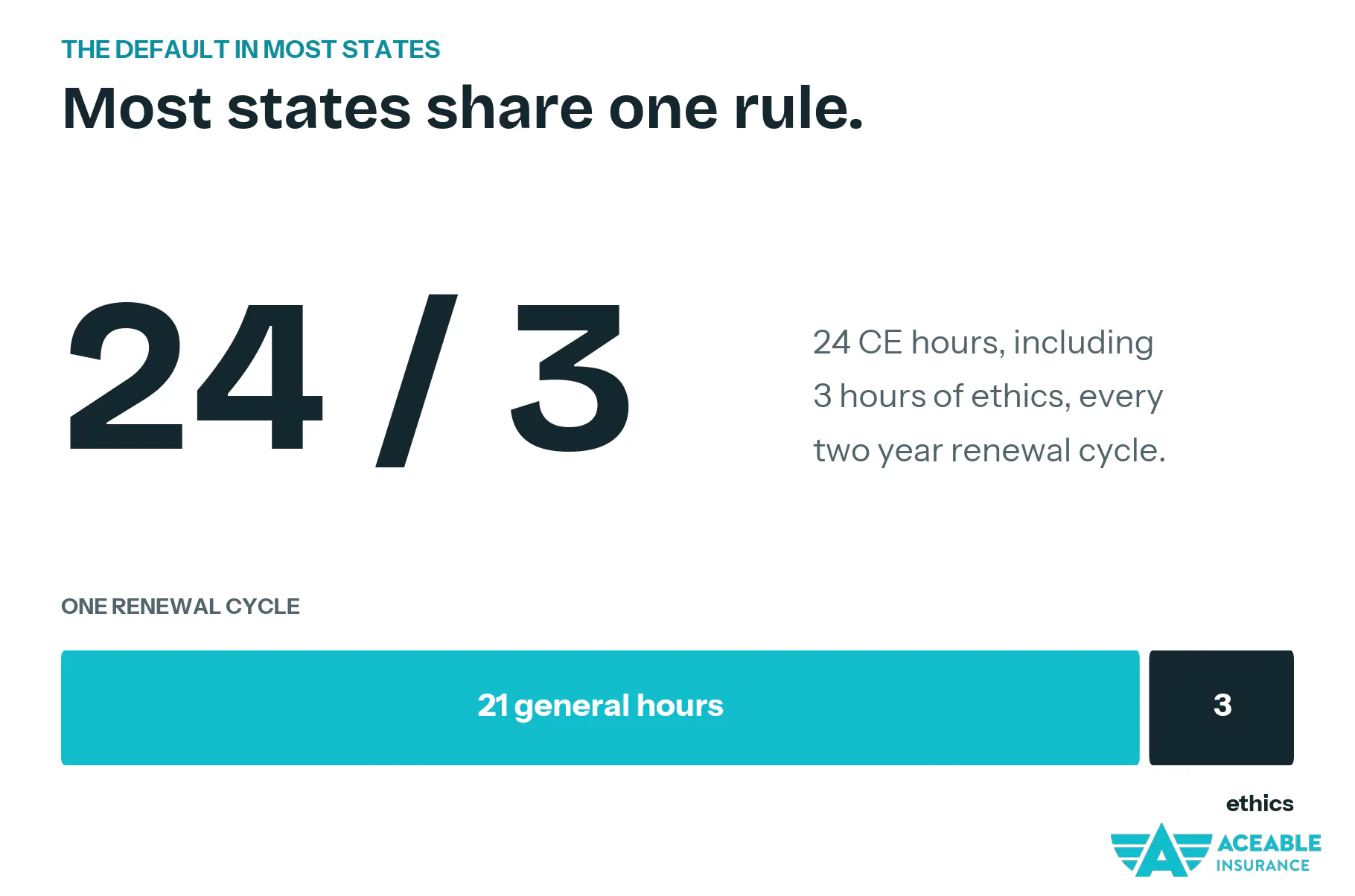
The most common framework in the country is 24 hours of CE, including 3 hours of ethics, completed every two years. That works out to 21 general hours plus 3 ethics hours per renewal cycle, and it is the default in the large majority of states.
If you hold licenses in multiple states, do not assume they all match. The outliers are easy to misjudge, and getting one wrong can mean a lapsed license, late fees, or lost selling time while you reinstate.

Here is the full line baseline for resident producers in every state: total CE hours, ethics hours, and how often you renew. States that break from the standard framework are covered in more detail below the list.
- Alabama: 24 hours, including 3 ethics hours, renewing every two years
- Alaska: 24 hours, including 3 ethics hours, renewing every two years
- Arizona: 48 hours, including 6 ethics hours, renewing every four years
- Arkansas: 24 hours, including 3 ethics hours, renewing every two years
- California: 24 hours, including 3 ethics hours, renewing every two years
- Colorado: 24 hours, including 3 ethics hours, renewing every two years
- Connecticut: 24 hours, including 3 ethics hours, renewing every two years
- Delaware: 24 hours, including 3 ethics hours, renewing every two years
- District of Columbia: 24 hours, including 3 ethics hours, renewing every two years
- Florida: 24 hours, including 4 ethics hours, renewing every two years (drops to 20 hours once licensed six or more years)
- Georgia: 24 hours, including 3 ethics hours, renewing every two years
- Hawaii: 24 hours, including 3 ethics hours, renewing every two years
- Idaho: 24 hours, including 3 ethics hours, renewing every two years
- Illinois: 24 hours, including 3 ethics hours, renewing every two years
- Indiana: 24 hours, including 3 ethics hours, renewing every two years
- Iowa: 36 hours, including 3 ethics hours, renewing every three years
- Kansas: 24 hours, including 3 ethics hours, renewing every two years
- Kentucky: 24 hours, including 3 ethics hours, renewing every two years
- Louisiana: 24 hours, including 3 ethics hours, renewing every two years
- Maine: 24 hours, including 3 ethics hours, renewing every two years
- Maryland: 24 hours, including 3 ethics hours, renewing every two years
- Massachusetts: 24 hours, including 3 ethics hours, renewing every two years
- Michigan: 24 hours, including 3 ethics hours, renewing every two years
- Minnesota: 24 hours, including 3 ethics hours, renewing every two years
- Mississippi: 24 hours, including 3 ethics hours, renewing every two years
- Missouri: 16 hours, including 3 ethics hours, renewing every two years
- Montana: 24 hours, including 3 ethics hours, renewing every two years
- Nebraska: 24 hours, including 3 ethics hours, renewing every two years
- Nevada: 24 hours, including 3 ethics hours, renewing every three years
- New Hampshire: 24 hours, including 3 ethics hours, renewing every two years
- New Jersey: 24 hours, including 3 ethics hours, renewing every two years
- New Mexico: 24 hours, including 3 ethics hours, renewing every two years
- New York: 15 hours, including 3 ethics hours, renewing every two years
- North Carolina: 24 hours, including 3 ethics hours, renewing every two years
- North Dakota: 24 hours, including 3 ethics hours, renewing every two years
- Ohio: 24 hours, including 3 ethics hours, renewing every two years
- Oklahoma: 24 hours, including 3 ethics hours, renewing every two years
- Oregon: 24 hours, including 3 ethics hours, renewing every two years
- Pennsylvania: 24 hours, including 3 ethics hours, renewing every two years
- Rhode Island: 24 hours, including 3 ethics hours, renewing every two years
- South Carolina: 24 hours, including 3 ethics hours, renewing every two years
- South Dakota: 24 hours, including 3 ethics hours, renewing every two years
- Tennessee: 24 hours, including 3 ethics hours, renewing every two years
- Texas: 24 hours, including 3 ethics hours, renewing every two years
- Utah: 24 hours, including 3 ethics hours, renewing every two years
- Vermont: 24 hours, including 3 ethics hours, renewing every two years
- Virginia: 24 hours, including 3 ethics hours, renewing every two years
- Washington: 24 hours, including 3 ethics hours, renewing every two years
- West Virginia: 24 hours, including 3 ethics hours, renewing every two years
- Wisconsin: 24 hours, including 3 ethics hours, renewing every two years
- Wyoming: 24 hours, including 3 ethics hours, renewing every two years
Figures reflect the full line baseline for resident producers and are compiled from state Department of Insurance and accredited provider sources. Requirements change, so confirm your exact obligation with your state Department of Insurance before renewal.
States that break the mold
A few states are worth calling out because they sit well outside the standard framework.

New York
New York requires just 15 hours per renewal, the lowest full line requirement in the country. Do not let the low number lull you. New York is strict about approved coursework, so verify your provider is authorized before you enroll.
Arizona
Arizona looks heavy at 48 hours with 6 hours of ethics, but licenses there renew on a four-year term. Spread across the cycle, the annual pace is comparable to the national standard. The risk is procrastination: four years is a long runway to forget about.
Iowa
Iowa requires 36 hours on a three year cycle. Agents moving in from a two year state often miscount here, so recalibrate your pacing when you pick up an Iowa license.
Missouri
Missouri sets the lowest hourly floor among standard cycle states at 16 hours every two years, still including 3 hours of ethics.
Nevada
Nevada follows the common 24 and 3 structure but runs it on a three-year cycle rather than two.
Florida
Florida requires 24 hours per cycle with an elevated ethics component, and the requirement drops to 20 hours once you have held your license for six or more years. Newer agents carry the higher load.
California
California follows the standard 24 and 3 framework for most producers, but agents holding the Limited Lines Auto license have a reduced requirement of 20 hours.
Recent changes agents are missing
Three shifts have caught agents off guard.
- California dropped its education requirement for new licensees. Under AB 943, candidates no longer complete traditional licensing education before the exam. Only a Code and Ethics course totaling 12 hours is required to get licensed. This changes the on ramp for new agents, not the CE obligation for existing licensees.
- Georgia rewards tenure. Licensees with 20 or more years of service now receive an automatic reduction of 4 CE hours, bringing their requirement down to 20 hours per renewal.
- Pennsylvania tightened ethics. Renewal now requires 3 hours of state approved ethics CE. Older ethics courses may no longer count, so confirm your ethics hours come from an approved provider before you sit for them.
Choose a State and Course
The deadline behind the deadline
Here is the rule that lapses more licenses than any hour requirement: providers can take up to 30 days to report your completed hours to the state. If you finish your final course on your expiration date, the state may not see your credits in time, and your license can lapse even though you technically did the work.
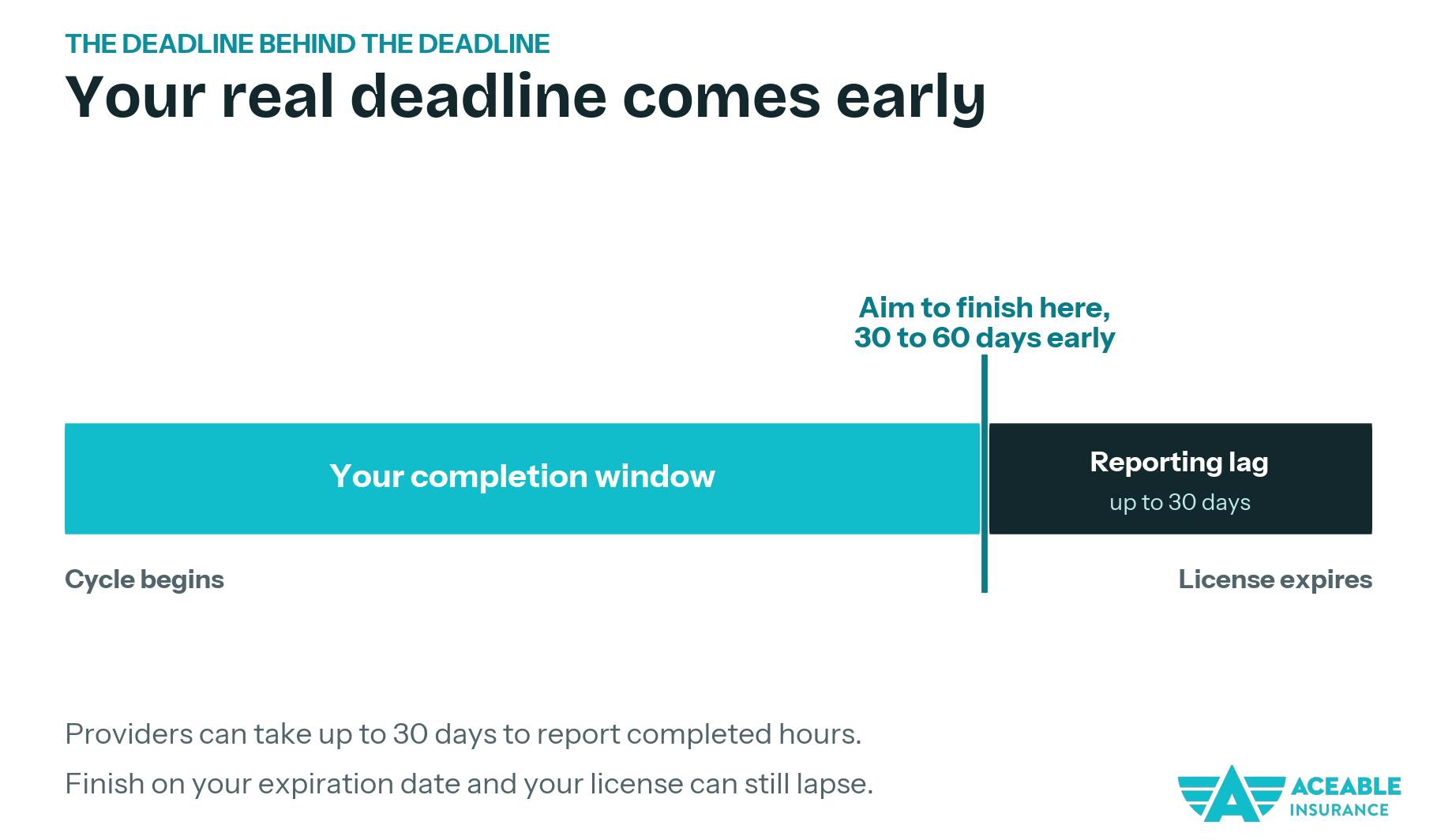
Treat your real deadline as 30 to 60 days before the date on your license. Finishing early costs you nothing. Finishing on time can still cost you your license. For what it is worth, Aceable reports completed credits to the state within one to two business days, but even then, finishing at least ten days early is the safe play.
How to stay compliant without thinking about it
Three habits keep a license current in any state.
- Know your number. Most agents need 24 hours with 3 hours of ethics every two years, but the outliers above are easy to misjudge. Confirm the requirement for every state where you hold a resident or nonresident license.
- Spread it out. Treat CE as a quarterly habit instead of a renewal week scramble. Under an hour a month covers the standard requirement.
- Finish early. Build the reporting lag into your plan and wrap your hours 30 to 60 days before your deadline.
Frequently asked questions
Do CE hours carry over to the next renewal cycle?
In most states, no. Extra hours completed in one cycle generally do not apply to the next one. A small number of states make exceptions, so check with your state Department of Insurance before banking on carryover.
Do I need CE for a nonresident license?
Usually not separately. Most states extend reciprocity, meaning that satisfying your home state CE requirement keeps your nonresident licenses in good standing. Verify this for each state where you are licensed, because a few have line specific exceptions.
What happens if I miss my CE deadline?
Your license can lapse, which typically means reinstatement fees, possible penalty hours, and no ability to legally sell until you are back in good standing. Some states offer a short grace period, but commissions and appointments can be disrupted even inside it.
How do I check how many hours I have completed?
Your state Department of Insurance licensing portal shows your reported hours. Remember the reporting lag: recently completed courses may take up to 30 days to appear.
Does ethics CE have to be a separate course?
It depends on the state. Some accept ethics content embedded in broader coursework, while others, like Pennsylvania, require hours from specifically approved ethics courses. When in doubt, take a dedicated, state approved ethics course.

Your state's requirement, handled.
Now that you know your number, Aceable's CE courses cover the full requirement, ethics included, without eating your selling time.